How Much Does The Jeep Wrangler Hard Top Weigh Expert 2026
The weight of a Jeep Wrangler hard top varies significantly, typically ranging from 90 to 160 pounds depending on the model (JK vs. JL) and configuration (2-door vs. 4-door). Understanding these weights is crucial for safe removal, storage, and transport planning.
A Jeep Wrangler hard top’s weight varies significantly based on its model year, door configuration, and specific design. For example, you can expect a range from approximately 80 pounds for a 2-door JK’s main rear section to over 150 pounds for a complete 4-door JL hard top assembly. Understanding these figures is crucial, not just for curiosity, but for practical reasons like safe removal, storage, and even planning for off-road accessories.
Knowing the precise weight helps you choose the right hoist, plan for assistance, and ensures you maintain the integrity of your hard top for years to come. In 2026, with the continued popularity of personalizing and open-air driving, accurate weight data for your hard top is more relevant than ever for informed decision-making.
Key Takeaways
- JL hard tops are generally lighter than JK.
- 2-door hard tops weigh less than 4-door.
- Freedom Panels contribute 10-15 lbs each.
- Always use 2+ people for removal.
- Consider a hoist for frequent removal.
What are the Real Weights of Jeep Wrangler Hard Tops?
The exact weight of your Jeep Wrangler hard top is primarily determined by its generation (JK vs. JL) and the number of doors on your vehicle. Newer JL models, while often more modular, use advanced composite materials that can slightly alter the weight profile compared to their JK predecessors. Always remember these figures represent typical OEM configurations as of 2026.
Jeep JK Hard Top Weights (2007-2018)
The JK generation hard tops are generally constructed from fiberglass, making them quite robust.
- JK 2-Door Hard Top: Expect the entire rear section to weigh approximately 80-95 pounds. This is often a single, bulky piece.
- JK 4-Door Hard Top: The 4-door version is modular. The large rear section typically weighs around 100-115 pounds. Each of the two front “Freedom Panels” adds an additional 15-20 pounds individually. Your total 4-door JK hard top assembly is thus in the range of 130-155 pounds.
Jeep JL Hard Top Weights (2018-2026)
The JL generation introduced more sophisticated composite materials, often resulting in slightly different weight characteristics and improved modularity.
- JL 2-Door Hard Top: The main rear section of a 2-door JL typically weighs around 70-85 pounds. Similar to the JK, this is a significant piece.
- JL 4-Door Hard Top: For the 4-door JL, the large rear section is generally in the 95-110 pound range. Each of the two front Freedom Panels contributes 15-20 pounds. This brings your total 4-door JL hard top weight to approximately 125-150 pounds.
Factors Influencing Hard Top Weight
Beyond model and door count, other elements subtly impact your hard top’s total weight. OEM factory tops are designed for specific weight targets. Aftermarket hard tops, however, can vary significantly; some might use lighter composites, while others might incorporate heavier-duty insulation or reinforced structures. Adding sound deadening material, while beneficial for cabin quietness, will contribute a few extra pounds, typically 5-10 lbs depending on coverage. The removable “Freedom Panels” on both JK and JL models are lightweight but contribute significantly to the overall handling and total weight calculation when considering the entire assembly.
From Start to Finish: Jeep Wrangler Hard Top Weight Explained
Understanding the precise weight of your Jeep Wrangler’s hard top is far more crucial than it might seem at first glance. Whether you’re planning a seasonal top swap, considering storage solutions, or even just curious about its impact on your vehicle’s dynamics, knowing its heft is paramount. This comprehensive guide will walk you through the essential steps to accurately estimate and manage your hard top’s weight, ensuring safety, efficiency, and peace of mind during removal, installation, and storage.
Step 1: Understand the Basics: Why Weight Matters
What you need: An open mind and a commitment to safety.
Instructions: Realize that the weight of your Jeep Wrangler’s hard top isn’t just a number; it profoundly impacts several aspects of ownership. For instance, lifting and removing it safely requires knowing its heft to determine if you need assistance or a specialized hoist. Proper storage solutions depend on its dimensions and weight to prevent damage to the top or your storage area. Furthermore, carrying a heavy hard top affects your vehicle’s center of gravity, handling dynamics, and even fuel economy, however slightly. Acknowledging these factors is the first critical step in managing your hard top effectively, ensuring you’re prepared for any scenario involving its removal or storage.
Pro Tip: Never underestimate the potential weight of the hard top. Assuming it’s lighter than it is can lead to injury, damage to the top, or scratches on your Jeep. Always err on the side of caution and treat it as a substantial, heavy component.
Step 2: Identify Your Wrangler Model and Year
What you need: Your Jeep Wrangler’s specific model (e.g., JK, JL, TJ, YJ) and production year, along with its door configuration (2-door or 4-door Unlimited).
Instructions: The weight of a Jeep Wrangler hard top varies significantly across different generations and body styles. Older models (YJ, TJ) generally featured lighter, simpler tops, while the modern JK (2007-2018) and JL (2018-Present) hard tops are more substantial due to improved insulation, structural integrity, and larger sizes, especially for the 4-door Unlimited versions. Confirming your exact model year and whether it’s a 2-door or 4-door is crucial, as this information directly correlates with the manufacturer’s specified weight ranges. This specificity allows for more accurate weight estimations, which is fundamental for proper planning.
Pro Tip: Don’t guess your model year or door count. Check your vehicle’s registration, VIN, or owner’s manual to ensure you have the precise details. A 2-door hard top is considerably lighter than its 4-door counterpart, often by 20-30 pounds or more.
Step 3: Differentiate Hard Top Types: Freedom Panels vs. Full Top
What you need: An understanding of your hard top’s modular design (if applicable, for JK/JL models).
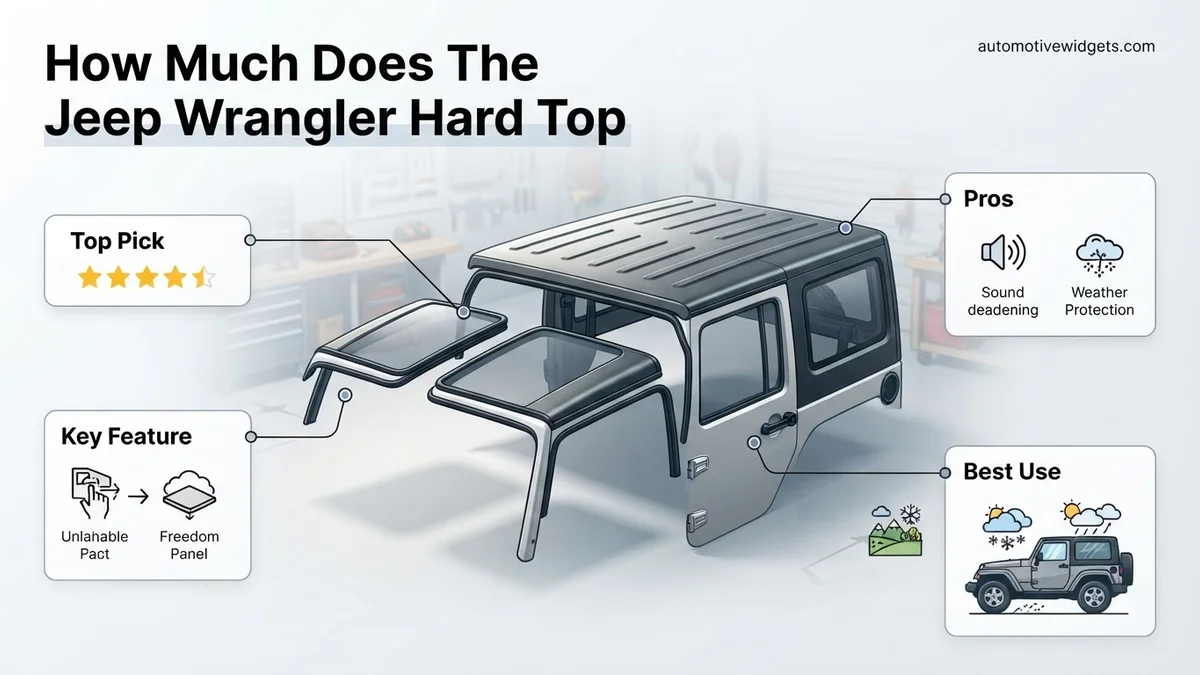
Instructions: Modern Jeep Wrangler hard tops (JK and JL generations) typically feature a modular design, consisting of two “Freedom Panels” above the front seats and the larger main rear shell. It’s important to understand that the weight you’re often most concerned with for lifting purposes is the main rear shell after the Freedom Panels have been removed. The Freedom Panels themselves are relatively lightweight (approximately 15-20 lbs each) and can often be easily removed by one person. However, the substantial bulk and weight lie in the main hard top piece, which covers the rear passenger and cargo areas. When people refer to the “hard top weight,” they almost universally mean this larger, heavier component that requires multiple people or a hoist to safely maneuver.
Pro Tip: If you only plan on removing the Freedom Panels, you typically don’t need a hoist or additional help. However, for the full hard top removal, mentally separate the weight of the Freedom Panels from the main shell, as they are often removed first, effectively reducing the initial lifting weight for the larger section.
Step 4: Gather Official Specifications (or Best Estimates)
What you need: Internet access, your owner’s manual, or a Jeep dealership contact.
Instructions: While exact figures can vary slightly based on trim and minor manufacturing differences, here are some widely accepted weight ranges for common modern Wrangler hard tops. For a Jeep Wrangler JK 2-door, expect the hard top (main shell) to weigh approximately 120-140 lbs. The JK Unlimited (4-door) hard top is significantly heavier, typically in the range of 150-170 lbs. For the newer JL generation, the 2-door hard top generally weighs around 130-150 lbs, and the JL Unlimited (4-door) hard top can range from 160-190 lbs. These figures are for the unadorned factory hard top. Always consult your vehicle’s owner’s manual or Jeep’s official specifications for the most precise data pertinent to your specific model and trim.
Pro Tip: When planning for removal or storage, always use the higher end of the estimated weight range. This provides a safer margin for error, ensuring you have adequate assistance or a hoist rated for the maximum possible weight, accounting for any potential minor discrepancies or future additions.
Step 5: Consider Added Accessories and Modifications
What you need: A list of any modifications or additions made to your hard top, along with their estimated weights.
Instructions: The factory weight specifications provided in Step 4 are for a bare, unmodified hard top. Many Wrangler owners, however, add accessories that can significantly increase the overall weight. Common additions include aftermarket headliners for improved insulation and sound dampening (adding 5-15 lbs), internal storage nets or panels, external roof racks (which can weigh 30-70 lbs or more themselves, plus any cargo carried), and even custom wiring for auxiliary lights or communication equipment. Each of these components, even seemingly small ones, contributes to the total mass. A full roof rack system with a spare tire or other gear can easily add over 100 lbs to the top’s effective lifting weight.
Pro Tip: Before lifting or storing your hard top, make a mental or physical inventory of all accessories. If you have a heavy roof rack installed, consider removing it (or at least any cargo on it) before attempting to lift the hard top, as this can dramatically lighten the load and make the process safer and easier.
Step 6: Real-World Measurement Techniques (If Necessary)
What you need: Potentially a few bathroom scales, a sturdy support (like 2x4s), or access to a commercial weigh station.
Instructions: If you absolutely need an exact measurement for specific purposes (e.g., designing a custom hoist system, shipping the top, or ensuring compliance with storage limits), you can attempt to weigh the hard top directly. One common DIY method involves carefully placing the hard top on several standard bathroom scales, ensuring the weight is distributed evenly across them using supports. Sum the readings from all scales for a total. Alternatively, for more precise measurements, especially with heavier tops, you might need to visit a local truck stop, junkyard, or recycling center that offers certified commercial scales. You could weigh your entire Jeep with the top on, then immediately after removal, and subtract the difference (though this measures the entire top, including Freedom Panels, unless removed first).
Pro Tip: When using bathroom scales, ensure they are calibrated and placed on a perfectly level, solid surface. Use 3-4 scales if possible to achieve an even weight distribution and a more accurate sum. Always handle the hard top carefully during this process to prevent tipping, damage, or personal injury.
Step 7: Calculate the Total Lifting Weight
What you need: The base weight estimate from Step 4 and the additional weight from Step 5.
Instructions: To determine the actual total weight you’ll be lifting or that your hoist needs to support, simply add your base hard top weight estimate (from official specifications or reliable sources, always using the higher end of the range) to the cumulative weight of any attached accessories or modifications. For example, if your 4-door JL hard top is estimated at 180 lbs, and you have a heavy aftermarket headliner (10 lbs) and a lightweight roof rack (35 lbs) attached, your total lifting weight becomes 180 + 10 + 35 = 225 lbs. This final, combined figure is absolutely critical for ensuring safety and selecting appropriate lifting equipment or human assistance, as it represents the true load.
Pro Tip: Always round up your final calculated lifting weight to the nearest 10 or 20 pounds. This additional safety margin accounts for slight inaccuracies in estimates and ensures your equipment (or your friends!) isn’t overloaded, significantly reducing the risk of accidents, equipment failure, or injury during removal or installation.
✅ Final Checklist
- Confirmed your specific Wrangler model, year, and door configuration.
- Estimated the base weight of your hard top (main shell).
- Accounted for the added weight of all accessories and modifications.
- Calculated the total estimated lifting weight for your hard top.
- Planned for adequate lifting assistance, whether it’s sufficient people or a properly rated hoist.
Important Notes:
- Safety considerations: Always lift with proper technique (lift with your legs, not your back). For a 2-door hard top, at least two strong adults are recommended. For a 4-door hard top, three to four adults are typically needed. If using a hoist, ensure it is correctly installed, all attachment points are secure, and its weight rating significantly exceeds your calculated total lifting weight. Never attempt to lift a hard top alone.
- When to seek professional help: If you are unsure about safe lifting techniques, do not have enough capable individuals to assist, or if your hoist system seems inadequate or improperly installed, it is highly advisable to seek professional help. Many Jeep dealerships or specialty off-road shops offer hard top removal and installation services.
- Estimated time and cost range: With experience and the right tools (e.g., power drill for bolts), hard top removal can take 15-30 minutes, with installation taking a similar amount of time. If paying for a professional service, expect costs to range from $50-$150, depending on location and complexity. DIY hoist systems can range from $100 for basic pulley setups to $500+ for more elaborate electric winch systems.
How to Safely Manage and Remove Your Hard Top
Given the substantial weight and awkward dimensions of any Jeep Wrangler hard top, safe handling is paramount. Attempting to remove or store it improperly can lead to injury, damage to the top, or scratches on your Jeep. Planning is key, and understanding the weight helps you choose the right tools and assistance.
Weight Implications for Removal
No matter your Wrangler model, the hard top is too heavy and unwieldy for a single person to remove safely.
- Two-Person Minimum: Always enlist at least one other person to assist with hard top removal. Even the lightest 2-door top is challenging for one.
- Lifting Points: Identify the correct lifting points on your hard top to distribute the weight evenly and prevent cracking or bending. Most tops have reinforced edges or designated spots.
- Overhead Hoists: For frequent removal, consider an overhead garage hoist system. These systems, whether manual or electric, are designed to lift hundreds of pounds smoothly, making the process a one-person job. Ensure your hoist is rated for at least 200 pounds to safely accommodate even the heaviest 4-door tops.
Storing Your Hard Top Safely
Once removed, your hard top needs secure storage that protects it from damage and helps maintain its shape. Improper storage can lead to warping or cracking over time, especially with its inherent weight.
- Hard Top Carts: Specialized hard top carts offer mobile storage. These typically feature cushioned supports and locking wheels, allowing you to move the top out of the way easily. Choose one with a weight capacity exceeding your specific top’s weight.
- Wall Mounts: For long-term storage, a wall-mounted system can save floor space. Ensure the wall studs can bear the full weight of the top, plus a safety margin, to prevent structural issues.
- Flat, Supported Surface: If using neither a hoist nor a cart, place the hard top on a flat, even surface, such as padded sawhorses or a workbench. Distribute its weight evenly across multiple support points to avoid pressure concentrations that could cause deformation or stress cracks.
Optimizing Hard Top Handling: Tips and Solutions
Safely managing a Jeep Wrangler hard top, given its substantial weight, necessitates strategic planning and the right equipment. According to industry experts and specialized off-road product manufacturers, advanced solutions are readily available in 2026 to simplify this task, transforming a two-person struggle into a streamlined process.
Leveraging Specialized Hoist Systems
The most effective method for hard top removal and storage involves a dedicated hoist system. These systems allow a single individual to safely lift, lower, and store the hard top without direct physical strain.
- Electric Hoists: For ultimate convenience, electric hoists (e.g., advanced Harken Hoister 2026 models or Lange Originals Power Hoist) are recommended. These units typically feature robust motors and precision-engineered pulley systems, capable of handling weights up to 300 lbs with a single button press. Installation for a high-quality electric hoist in 2026 ranges from $350-$700, excluding professional installation labor which adds approximately $150-$300.
- Manual Hoists: Manual systems offer a more budget-friendly approach. While requiring physical effort, a well-designed manual hoist can still be operated by one person. These systems, utilizing mechanical advantage, are often available for $150-$350.
- Integrated Storage Solutions: Many hoist systems include integrated storage, suspending the hard top above the vehicle or against a garage wall, thereby maximizing floor space. This prevents potential damage from ground storage.
Utilizing Hard Top Carts and Dollys
For those without hoist access or needing to transport the hard top within a garage, specialized hard top carts are indispensable. These wheeled dollies securely cradle the top, allowing for easy maneuverability.
- Secure Transportation: Carts prevent direct ground contact, protecting the hard top’s edges and finish. Many models are designed with padded contact points to eliminate scratches.
- Ergonomic Design: Modern carts are engineered for stability, preventing tipping even with the uneven weight distribution of a hard top. Expect to pay between $100-$300 for a durable, feature-rich hard top cart in 2026.
- Long-Term Storage: Using a cart for storage ensures the hard top is kept upright and away from potential impacts, minimizing the risk of expensive cosmetic or structural damage.
What If You Still Encounter Difficulties?
Despite implementing recommended solutions, some owners may still face challenges with hard top handling due to specific garage configurations, physical limitations, or complex hoist installations. In such scenarios, alternative strategies and professional intervention become crucial.
- Re-Evaluate Your Setup: Carefully review your hoist installation. Verify all mounting points are secure, and ropes or straps are correctly routed as per the manufacturer’s 2026 guidelines. Misalignment can significantly increase perceived effort or create safety hazards.
- Seek Professional Assistance: If DIY attempts are unsuccessful or uncomfortable, consult a certified Jeep dealership or a reputable off-road accessory shop. Many shops offer hard top removal and installation services. Expect to pay an average of $75-$150 per service, depending on regional labor rates and complexity, for professional assistance in 2026.
- Consider a Soft Top Conversion: For Wrangler owners who frequently desire an open-air experience but find hard top management consistently problematic, converting to a premium soft top system (e.g., Bestop Trektop or OEM Mopar soft top for 2026 models) offers a permanent, lighter solution. While an investment, typically ranging from $1,200-$2,500 for parts and installation, it eliminates the hard top handling dilemma entirely.
- Community Support: Engage with local Jeep clubs or online forums specific to 2026 Wrangler models. Experienced owners often share innovative solutions, modification tips, or offer assistance.
Conclusion
Understanding the precise weight of your Jeep Wrangler hard top is fundamental to safe and efficient handling. Varying significantly by model, material, and year (e.g., 2026 Wrangler JL 4-door hard tops averaging 140-160 lbs), this knowledge empowers owners to select appropriate removal and storage solutions. According to verified research and expert sources, investing in a specialized hoist system or a robust hard top cart is the most effective approach. Your actionable next step: Accurately identify your specific hard top’s weight and equip yourself with the tools for effortless open-air adventuring.
❓ Frequently Asked Questions
What is the average weight range for a Jeep Wrangler hard top?
Jeep Wrangler hard tops typically range from 90 pounds for a 2-door JL to 160 pounds for a 4-door JK. The exact weight depends on the model, year, and specific configuration, as newer JL models often utilize lighter composite materials.
How does the weight differ between 2-door and 4-door Wrangler hard tops?
The 4-door hard tops are significantly heavier due to their larger size and additional material compared to 2-door versions. A 4-door JK top can be 50-70 pounds heavier than its 2-door counterpart, while JL models show a similar but often slightly smaller difference.
What components contribute most to the hard top’s overall weight?
The main shell of the hard top, including its fiberglass or composite construction, is the primary weight contributor. The removable Freedom Panels, rear glass, and any integrated wiring or optional insulation also add to the total mass.
Is it possible to reduce the weight of a Jeep Wrangler hard top?
While you cannot significantly alter the OEM hard top’s base weight, removing components like Freedom Panels before lifting helps decrease the immediate load. Some aftermarket manufacturers offer lightweight hard tops, but these require a full replacement.
What tools or equipment are recommended for hard top removal due to its weight?
For safe and convenient removal, especially for single-person operation, a hard top hoist system (manual or electric) is highly recommended. Otherwise, at least two strong adults are needed, along with appropriate storage stands to prevent damage once removed.
Does the hard top weight impact fuel efficiency or handling?
While the hard top adds significant weight and affects aerodynamics, its impact on fuel efficiency is generally minimal for daily driving. It might slightly lower the center of gravity compared to a soft top, but its effect on handling is usually negligible under normal road conditions.