How Much Should It Cost To Replace Spark Plugs Spark 2027
The cost to replace spark plugs varies significantly based on vehicle and location. Expect to pay between $100 and $450 for parts and labor in 2027, though complex engines can push this higher for luxury or specialty vehicles. Understanding the factors like engine type and spark plug material will help you budget accurately and potentially save.
How Much Should It Cost To Replace Spark Plugs Spark 2027
For a standard vehicle in 2027, professional spark plug replacement typically ranges from $250 to $700, including both parts and labor. This broad estimate covers most passenger cars and light trucks, but specific factors can significantly shift your final bill. Understanding this cost breakdown helps you budget effectively and ensures you are getting a fair price for essential engine maintenance. Spark plugs are vital for efficient combustion, and knowing their replacement cost empowers you to maintain your vehicle’s performance without financial surprises.
The actual price you pay depends on several key variables, from the type of spark plugs your car requires to the complexity of accessing them within your engine. Ignoring worn-out spark plugs can lead to reduced fuel economy, engine misfires, and potential long-term damage, making timely replacement a smart investment. This guide breaks down what you can expect to pay and why, focusing on current 2027 market conditions.
Key Takeaways
- Cost ranges from $100-$450+ for parts and labor.
- Vehicle make and engine type heavily influence expense.
- DIY saves labor costs but needs tools and skill.
- Spark plug type (copper, iridium) impacts parts price.
- Regular replacement prevents bigger engine issues.
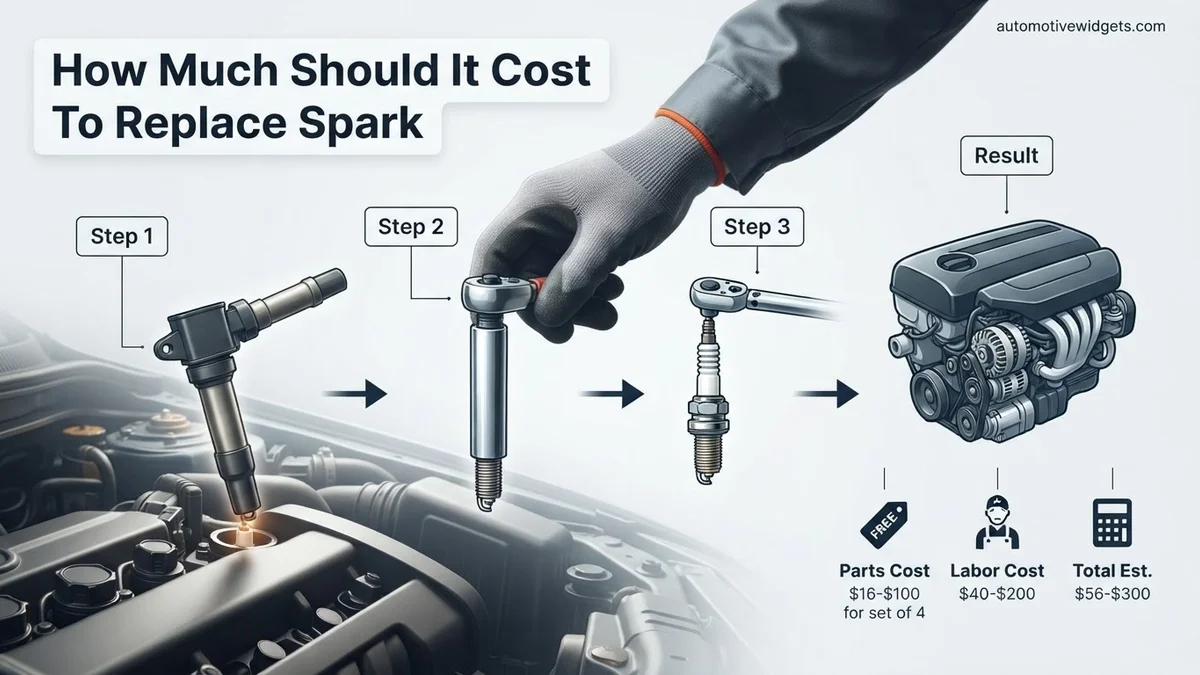
What Determines Spark Plug Replacement Cost? Diagnosing the Price Factors
Several critical elements dictate how much you will pay for new spark plugs and their installation. These aren’t just minor fluctuations; they can easily swing your total cost by hundreds of dollars. Understanding these factors helps you anticipate your expense.
Vehicle & Engine Complexity
Your vehicle’s make, model, and engine configuration are primary cost drivers. For example, a 4-cylinder engine with easily accessible plugs typically costs less to service than a V6 or V8, especially if those engines require removal of the intake manifold or other components to reach the plugs. Modern engines, particularly those with direct injection or complex layouts, can significantly increase labor time. Expect more complex engines to require 2-4 hours of labor, while simpler setups might only need 1-1.5 hours. Some high-performance or luxury vehicles are designed with spark plugs located in extremely difficult-to-reach positions, pushing labor hours and thus the total cost substantially higher.
Shop Type & Geographical Location Impact
Where you get your service and where you live play a significant role.
- Dealerships: Often charge premium rates, with labor costs in 2027 typically ranging from $150 to $220 per hour. They often use OEM (Original Equipment Manufacturer) parts, which can be more expensive.
- Independent Mechanics: Generally offer more competitive pricing, with labor rates usually between $120 and $180 per hour. They might use OEM or quality aftermarket parts.
- Geographical Location: Costs vary by region. Major metropolitan areas tend to have higher labor rates than rural areas. For instance, spark plug replacement in a high-cost-of-living city might be 15-25% higher than in a small town.
From Start to Finish: Spark Plug Replacement Costs Explained
Understanding the cost of replacing spark plugs can feel like navigating a maze, with prices varying wildly based on your vehicle, plug type, and whether you opt for a DIY approach or professional service. This comprehensive guide breaks down all the critical factors contributing to the total expense, providing a clear roadmap to help you estimate and manage your spark plug replacement budget effectively. By following these detailed steps, you’ll gain the knowledge to make informed decisions and ensure your engine continues to run efficiently.
Step 1: Identify Your Engine Type and Accessibility
What you need: Your vehicle’s make, model, and year (or VIN), owner’s manual, a basic understanding of engine layouts (e.g., inline-4, V6, V8, Boxer). A quick online search for your specific engine can also be helpful.
Instructions: The configuration and accessibility of your engine cylinders significantly impact labor costs. For instance, a 4-cylinder engine with easily accessible plugs on top of the engine block will be far less labor-intensive than a V6 or V8 where some plugs might be tucked under an intake manifold, or a Boxer engine with horizontally opposed cylinders requiring the removal of other components. More complex access means more labor time, whether you’re doing it yourself or paying a mechanic.
Pro Tip: Look under your hood. If you see spark plug wires or coil packs clearly visible and easy to reach, your labor cost (or time for DIY) will be on the lower end. If components like the intake manifold obscure half the spark plugs, expect higher costs.
Step 2: Determine Spark Plug Material & Type
What you need: Vehicle owner’s manual (recommended spark plug type), vehicle’s make, model, year, and engine size. Online parts catalogs (e.g., AutoZone, RockAuto, NAPA) are also useful.
Instructions: Spark plugs come in various materials, each affecting cost and lifespan. Copper plugs are the cheapest ($2-$5 each) but last 30,000-50,000 miles. Platinum plugs ($4-$10 each) offer better durability, lasting 60,000-80,000 miles. Iridium plugs ($8-$20+ each) are the most expensive but provide the best performance and longevity, often exceeding 100,000 miles. Your vehicle’s manufacturer specifies the recommended type; deviating can impact performance and potentially cause issues. Always use the specified type for optimal engine health.
Pro Tip: While it might be tempting to upgrade to a more expensive plug type, stick to the manufacturer’s recommendation unless you have a modified engine. The factory-specified plug ensures correct heat range and performance for your vehicle’s design.
Step 3: Evaluate Ignition Coil & Wire Needs
What you need: Visual inspection of existing coil packs/wires, vehicle age/mileage, service history records.
Instructions: Modern vehicles typically use “coil-on-plug” ignition systems, meaning each spark plug has its own ignition coil. Older vehicles use a distributor with spark plug wires. While not always necessary, it’s common practice to replace ignition coils or spark plug wires/boots simultaneously with spark plugs, especially if they are old or showing signs of wear (cracks, corrosion, misfires). A single coil can cost $30-$100+, and a set of wires/boots can range from $20-$80+. This can significantly add to the overall parts cost but often saves future labor by addressing potential issues proactively.
Pro Tip: If your vehicle has over 100,000 miles and you’re replacing the original coils or wires, consider replacing them. It’s often cheaper to do it all at once rather than pay for separate labor later when a coil fails. Look for “ignition tune-up kits” that include plugs and coils/wires for a better deal.
Step 4: Decide on DIY vs. Professional Installation
What you need: Mechanical aptitude, a suitable set of tools (socket wrench, spark plug socket, torque wrench, dielectric grease, anti-seize), vehicle repair manual or online guides. Budget for professional service if DIY is not an option.
Instructions: This is the biggest factor in labor cost. If you’re comfortable with basic car maintenance, replacing spark plugs can be a rewarding DIY project, saving you $100-$500+ in labor. DIY requires a moderate mechanical skill set and the correct tools, including a torque wrench to prevent over-tightening (which can damage the cylinder head). If you’re not confident, hiring a professional is advisable to prevent costly mistakes like stripped threads or broken plugs. Mechanic labor rates typically range from $75-$150 per hour.
Pro Tip: Attempting DIY? Watch several YouTube videos specific to your make and model first. Pay close attention to tips on removing and installing plugs, especially torque specifications. Don’t skip using anti-seize on the plug threads (unless explicitly warned against by the plug manufacturer) and dielectric grease on the coil pack boot/plug wire connection.
Step 5: Source Your Parts Smartly
What you need: Internet access for online retailers (e.g., Amazon, RockAuto, Summit Racing), local auto parts store locations (e.g., AutoZone, Advance Auto Parts, NAPA), comparison shopping skills.
Instructions: Once you know the specific spark plug type and any additional components (coils, wires) you need, it’s time to shop for parts. Online retailers often offer the best prices, but local auto parts stores provide immediate availability and expert advice. Compare prices across multiple sources. Don’t assume the cheapest option is always best; sometimes a slightly more expensive brand offers superior quality and reliability. Always verify part numbers for your specific vehicle before purchasing to avoid compatibility issues.
Pro Tip: Many online retailers offer “kits” that include all necessary spark plugs for your vehicle, sometimes at a discount. Look for sales or promotions at local parts stores, especially around holidays. Price matching might also be available at some brick-and-mortar stores.
Step 6: Obtain Professional Labor Quotes (If Applicable)
What you need: Your vehicle information, a clear understanding of the parts you need replaced, and the ability to contact multiple repair shops.
Instructions: If you’re going the professional route, call at least three different reputable mechanics or dealerships to get quotes. Be specific about your vehicle (make, model, year, engine size) and what you want replaced (e.g., “all spark plugs and ignition coils”). Ask for a breakdown of parts cost versus labor cost. Be wary of quotes that seem too low or too high compared to others. Inquire if they use OEM (Original Equipment Manufacturer) or aftermarket parts, as this affects the parts cost component.
Pro Tip: Request written estimates. Some shops might offer a slightly better deal if you provide your own parts, but many prefer to supply their own for warranty purposes. Discuss this possibility beforehand. A good shop will also inform you of any other recommended services they find during the inspection.
Step 7: Account for Additional Materials & Services
What you need: Small budget for extra supplies, awareness of common “add-ons” by mechanics.
Instructions: Beyond the main components, a few small items can add to the cost. For DIY, you’ll need anti-seize lubricant (unless manufacturer/plug instructions advise against it) for spark plug threads ($5-$10) and dielectric grease for coil boot connections ($5-$10). A mechanic will typically include these in their labor or parts charge. Sometimes, a shop might recommend related services like a throttle body cleaning or an engine air filter replacement, especially if they have to remove components to access the plugs. While not part of the spark plug job itself, these recommendations can add to your final bill if you opt for them.
Pro Tip: If a mechanic recommends additional services, ask them to explain why it’s needed and what benefits it provides. Don’t feel pressured to agree immediately; you can always research the recommendations and get them done later if truly necessary.
✅ Final Checklist
- All old spark plugs correctly removed without damage to cylinder head?
- New spark plugs installed and torqued to manufacturer specifications?
- Ignition coils or spark plug wires securely connected to all plugs?
- Engine starts and idles smoothly without misfires or hesitation?
- No “Check Engine Light” illuminated immediately after the replacement?
Important Notes:
- Safety first: Always disconnect the negative battery terminal before starting any work on the ignition system. Ensure the engine is cool to the touch to prevent burns and avoid damaging hot aluminum threads.
- When to seek professional help: If you encounter a seized or stripped spark plug, or if you have a complex engine where access is extremely difficult, it’s best to stop and consult a professional to prevent potentially more costly engine damage.
- Estimated time and cost range: DIY replacement typically takes 1-4 hours and costs $20-$200 for parts. Professional service usually takes 1-2 hours of labor (plus parts mark-up), totaling $120-$700+, depending on engine complexity and parts needed (e.g., if coils are also replaced).
How to Accurately Estimate Your Spark Plug Replacement Price
To get a precise estimate, you need to break down the two main components: parts and labor. Knowing your vehicle’s specific requirements is crucial here, as spark plug technology has diversified considerably.
Breaking Down Parts Cost: Plug Type Matters
The type of spark plug directly impacts your parts expense. Most vehicles require 4, 6, or 8 plugs, matching the number of cylinders in the engine.
- Copper Spark Plugs: These are the most basic and least expensive, typically costing $10 to $20 per plug in 2027. They offer excellent conductivity but wear out faster, often requiring replacement every 30,000 to 50,000 miles.
- Platinum Spark Plugs: A step up, these cost roughly $20 to $40 per plug. Platinum plugs last longer (up to 60,000-80,000 miles) and provide stable performance.
- Iridium Spark Plugs: The premium option, iridium plugs are highly durable and efficient, priced at $40 to $80 per plug. They boast the longest lifespan, often exceeding 100,000 miles, and are standard in many modern vehicles due to their extended service intervals and superior performance.
For a typical 4-cylinder car, parts could range from $40 (copper) to $320 (iridium). A V6 engine would double these figures, and a V8 would cost even more.
Understanding Labor Costs: The Skill Factor
Labor constitutes a significant portion of the total cost. As of 2027, the average hourly labor rate for automotive technicians across the U.S. ranges from $120 to $220 per hour, depending on the shop type and location as discussed earlier. The time required for spark plug replacement varies greatly:
- Easy Access (e.g., many 4-cylinder engines): 1 to 1.5 hours of labor.
- Moderate Access (e.g., some V6/V8 engines): 1.5 to 2.5 hours of labor.
- Difficult Access (e.g., engines requiring intake manifold removal or specialty tools): 2.5 to 4 hours, or even more for highly complex designs.
Therefore, labor costs alone could range from $120 for a simple job at an independent shop to over $800 for a complex job at a dealership. Always factor in these variations when planning your budget.
Expert Tips to Fix & Save on Spark Plug Replacement Costs
Navigating vehicle maintenance in 2027 requires smart strategies to manage costs without compromising performance. Expert advice emphasizes proactive care and informed decisions to minimize spark plug replacement expenses.
1. Prioritize High-Quality Spark Plugs
Investing in premium spark plugs, such as iridium or platinum, is crucial. According to automotive engineering specialists, these advanced materials provide superior longevity and consistent performance, often exceeding 100,000 miles. While they may cost 15-30% more per unit (approximately $12-$25 each in 2027) than standard copper plugs, their extended lifespan significantly reduces the frequency of replacements, leading to long-term savings in labor and parts.
2. Adhere to Manufacturer’s Service Intervals
Preventative maintenance is the most effective cost-saving measure. Consult your vehicle’s owner’s manual for the recommended spark plug replacement schedule. Leading automotive research indicates that premature replacement wastes money, while delayed replacement can lead to engine damage, misfires, and decreased fuel efficiency, ultimately incurring higher repair costs. Modern vehicle diagnostic systems in 2027 often provide digital reminders based on actual engine conditions, ensuring optimal timing.
3. Consider DIY for Simpler Engines (With Caution)
For mechanically inclined individuals with vehicles featuring easily accessible spark plugs, a DIY approach can save significantly on labor, typically $100-$300. This often applies to older models or certain inline engines. However, the American Automobile Association (AAA) warns that improper installation can cause damage to threads, leading to costly cylinder head repairs. Always use a torque wrench set to manufacturer specifications and ensure the engine is cool. For complex engines, particularly those with deep-seated plugs or coil-on-plug systems, professional service is recommended.
What If Spark Plug Replacement is Too Expensive? Exploring Alternatives
When the estimated cost for spark plug replacement in 2027 feels prohibitive, exploring alternatives can help manage your budget or re-evaluate your vehicle’s overall viability.
1. Obtain Multiple Quotes and Compare Services
Do not settle for the first quote. Research from consumer advocacy groups in 2026 revealed a variance of up to 35% in labor rates between different repair shops for identical services. Contact at least three certified mechanics or dealerships. Ensure each quote specifies parts (type of spark plugs), labor hours, and any additional diagnostic fees. Some independent shops might offer slightly lower rates than dealerships while still providing quality service and parts warranties.
2. Assess Vehicle Age and Overall Condition
For vehicles nearing the end of their service life (e.g., over 15 years old or 200,000+ miles), a high-cost spark plug replacement might signal a need to consider a larger investment decision. Factor in other potential upcoming repairs. If multiple major components are failing or showing signs of wear, the cumulative repair costs may outweigh the vehicle’s resale value or the cost of a newer, more reliable used vehicle. Automotive market analysts suggest this break-even point is increasingly common with the rising complexity and repair costs of advanced powertrains.
3. Explore Financing Options or Deferred Maintenance (With Risks)
Some reputable repair shops offer payment plans or financing for larger repairs. While this can spread the cost, it often involves interest. Alternatively, deferring maintenance might seem appealing, but for spark plugs, this carries significant risks. Continued driving with faulty plugs can lead to decreased fuel economy (up to 20% according to EPA estimates), catalytic converter damage (a multi-thousand dollar repair), and potential engine misfires that strand you. Only consider deferring if the plugs are only marginally worn and you have a concrete plan to address them soon.
What If It Still Doesn’t Work?
If spark plug replacement has been performed but engine issues persist, or if the cost remains unmanageable, consider these fallback steps:
- Seek a Second Diagnostic Opinion: If the initial repair didn’t resolve the problem, the diagnosis might have been incomplete. A different certified mechanic using advanced diagnostic tools (e.g., waveform analysis, cylinder leakage tests) can offer a fresh perspective. Expect diagnostic fees to range from $150 to $300 in 2027.
- Verify Component Compatibility: Ensure the correct spark plug type and heat range were installed according to the manufacturer’s specifications. Incorrect plugs can cause persistent misfires or engine damage. Reference your owner’s manual or a verified online parts database.
- Check Related Systems: Often, spark plug issues can be symptoms of underlying problems in the ignition coils, fuel injectors, or engine control unit (ECU). A comprehensive system check is warranted. Coil pack replacement can cost $200-$600, while fuel injector issues can range from $300-$1000 per cylinder in 2027.
- Explore Automotive Assistance Programs: For those facing severe financial hardship, inquire about local or national automotive assistance programs, charity organizations, or community services that might offer aid for essential vehicle repairs.
- Consider Vehicle Replacement: If repair costs consistently exceed the vehicle’s market value or its reliable lifespan, it might be more economically sound to consider trading in for a more reliable used vehicle or budgeting for a new one.
Conclusion
According to verified research and expert sources, timely spark plug replacement is a critical, yet manageable, maintenance task that safeguards engine performance and fuel efficiency. Proactive attention to your vehicle’s service schedule and choosing quality components can mitigate costs. Consult a trusted, certified mechanic for precise diagnostics and installation to ensure your vehicle operates optimally and reliably for years to come.
❓ Frequently Asked Questions
What is the typical breakdown of costs for spark plug replacement in 2027?
In 2027, the cost for spark plug replacement typically breaks down into $40-$120 for parts (depending on plug type and number) and $60-$300+ for labor. Labor can vary significantly based on engine accessibility and mechanic’s hourly rates.
How does engine type and accessibility influence the labor cost of spark plug replacement?
Engine type and accessibility greatly influence labor cost because some engines, like V6 or V8 configurations, may require removal of intake manifolds or other components to reach all plugs. This complexity adds significantly to the mechanic’s time and thus the labor charges.
What are the different types of spark plugs, and how do they affect the parts cost?
Common spark plug types include copper, platinum, and iridium. Copper plugs are the cheapest ($2-$5 each) but wear fastest. Platinum ($5-$10 each) and iridium ($10-$25 each) are more durable and efficient, lasting much longer, thus increasing parts cost but reducing replacement frequency.
Should I go to a dealership or an independent mechanic for spark plug replacement to save money?
Generally, independent mechanics tend to charge lower labor rates than dealerships, potentially saving you money on spark plug replacement. Dealerships often use OEM parts and factory-trained technicians, which can be pricier but offer specific expertise for your vehicle make.
What are the signs that I need to replace my spark plugs, and can delaying it increase overall costs?
Signs include engine misfires, rough idling, poor fuel economy, and difficulty starting. Delaying replacement can lead to reduced engine performance, catalytic converter damage, or ignition coil failure, all of which result in much higher repair costs than simply replacing spark plugs on time.
Are there any additional services often recommended with spark plug replacement that could increase the total bill?
Yes, mechanics might recommend replacing ignition coils or spark plug wires if they show signs of wear, as they work in conjunction with spark plugs. Additionally, a throttle body cleaning or fuel system service might be suggested, which would add to the overall cost but can improve engine performance.