Where Should The Temperature Gauge Be On A Car Expert 2027
Understanding where your car’s temperature gauge should normally be is crucial for engine health. A gauge in the middle range typically indicates optimal engine operating temperature, while readings too high or too low signal potential issues requiring attention.
Your car’s engine temperature gauge should consistently hover in the middle third of its range once the engine is fully warmed up. This “normal” operating zone typically represents coolant temperatures between 195°F and 220°F (90°C to 105°C). Maintaining this optimal temperature is crucial for engine longevity, fuel efficiency, and overall performance in 2027 vehicles.
Understanding where this needle should sit provides immediate insight into your engine’s health. Deviations from this sweet spot can signal issues requiring prompt attention, preventing costly repairs or even catastrophic engine failure down the line. It’s one of the most vital indicators on your dashboard, offering a direct window into your engine’s thermal stability.
Key Takeaways
- Normal gauge position:middle third.
- High gauge means overheating; act fast.
- Low gauge indicates under-cooling, poor efficiency.
- Monitor your gauge for early problem signs.
- Know your vehicle’s specific normal range.
What Your Car’s Temperature Gauge Really Measures
The “Normal” Operating Zone
The temperature gauge on your dashboard doesn’t measure the engine’s internal metal temperature directly. Instead, it reports the temperature of the engine coolant, a liquid circulating through the engine block, cylinder head, and radiator. For most modern vehicles in 2027, including advanced hybrids, this coolant temperature is meticulously managed by the Engine Control Unit (ECU) to maintain peak efficiency.
-
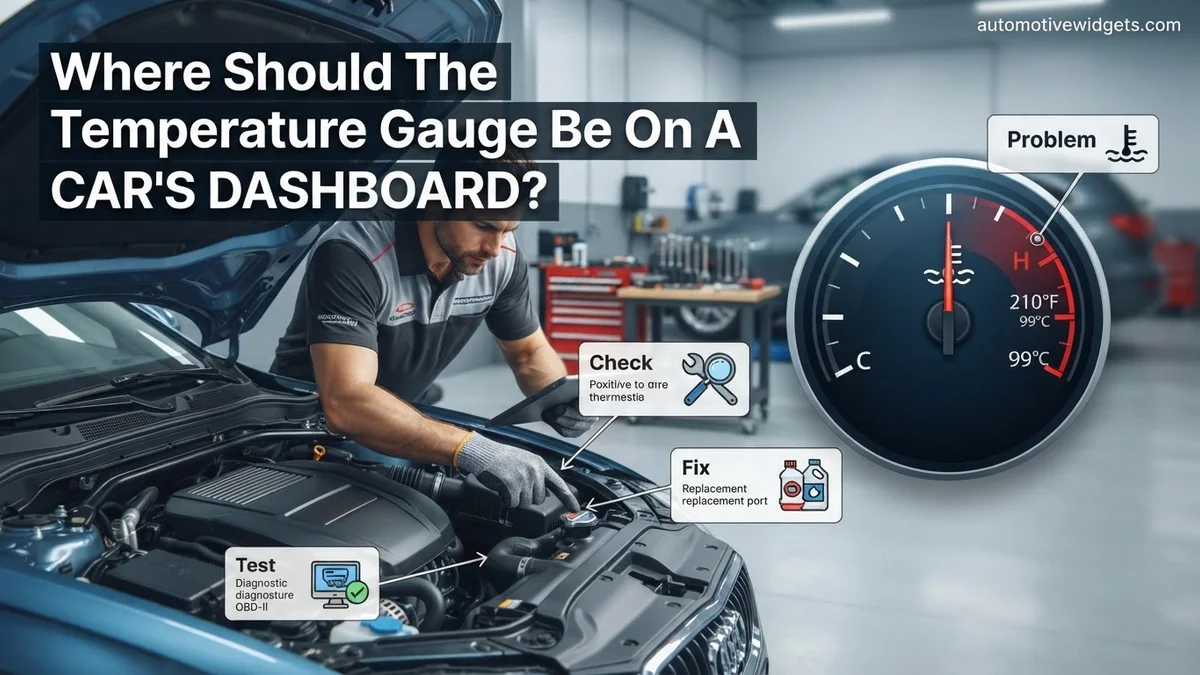
Visual Indicator: The needle should consistently point to the middle third of the gauge. This central zone is universally recognized as normal. Some digital dashboards in 2027 might display the exact temperature, but the analog sweep remains a common and intuitive visual. Expect it to sit squarely in the middle of the ‘C’ (cold) and ‘H’ (hot) range, never touching either extreme during normal operation.
-
Typical Coolant Temperatures: While specific ranges can vary slightly by manufacturer, the optimal window is consistent:
-
Fahrenheit: Approximately 195°F to 220°F.
-
Celsius: Roughly 90°C to 105°C.
-
This stable temperature ensures proper lubrication, efficient fuel combustion, and effective emissions control. Your car’s engine is precision-engineered to perform best within this thermal window, making the “middle third” a critical visual cue for its well-being.
Why the Middle Third is Optimal
Engineers design modern internal combustion engines to operate most efficiently within this very narrow temperature band, often called the “closed-loop” operating temperature. Maintaining this thermal equilibrium is paramount for your vehicle’s performance and longevity. Too cold, and components don’t expand optimally; fuel combustion is less complete, increasing emissions and reducing economy. Too hot, and vital fluids rapidly break down, components warp, and severe, often irreversible, engine damage can occur.
-
Fuel Efficiency: A properly warmed engine burns fuel more completely and efficiently, optimizing mileage.
-
Reduced Wear and Tear: Engine oil reaches its optimal viscosity at normal temperatures, providing superior lubrication and reducing friction, extending engine life.
-
Emissions Control: Your catalytic converter and other emissions systems operate most effectively at high temperatures, ensuring your vehicle meets 2027 environmental standards.
Consider the middle third of your temperature gauge as your engine’s happy place. Any sustained deviation warrants immediate attention to prevent long-term problems.
How to Understand Your Car’s Temperature Gauge Like a Pro: A Practical Walkthrough
The temperature gauge is one of the most critical instruments on your car’s dashboard, providing real-time insights into your engine’s health. Ignoring its readings can lead to severe engine damage, costly repairs, or even roadside breakdowns. This comprehensive guide will walk you through precisely where your temperature gauge should typically be during various driving conditions, how to interpret its signals, and what actions to take based on its readings. Understanding these steps is crucial for maintaining your vehicle’s longevity and ensuring your safety on the road.
Step 1: Locate Your Vehicle’s Temperature Gauge
What you need: Your vehicle, a clear view of the dashboard, and a few moments of undisturbed observation.
Instructions: Begin by familiarizing yourself with your car’s dashboard. The temperature gauge is typically located near the speedometer and tachometer, often paired with the fuel gauge. It usually resembles a thermometer or features markings like ‘C’ for Cold and ‘H’ for Hot, or a numerical scale ranging from 0 to 120 degrees Celsius/Fahrenheit. On some newer vehicles, especially those with digital dashboards, it might be an illuminated bar graph or a digital readout. Take a moment to identify its exact position and the scale it uses before you even start the engine.
Pro Tip: Consult your car’s owner’s manual if you have difficulty locating it. Modern cars sometimes integrate this into multi-function displays, so knowing where to cycle through menus is helpful.
Step 2: Interpret the Gauge Markings and Scales
What you need: Understanding of common automotive symbols.
Instructions: Once located, pay close attention to the markings. The ‘C’ (Cold) side typically indicates an engine temperature below optimal, while ‘H’ (Hot) signifies overheating. Many gauges also feature a central optimal operating range, often indicated by a distinct section or a color-coded zone (e.g., green or white). Some gauges might use a scale, for instance, 60-120°C (140-250°F), where the ideal operating temperature usually falls within 85-105°C (185-220°F). Familiarize yourself with these specific indicators for your vehicle.
Pro Tip: Avoid confusing the temperature gauge with the fuel gauge, which often looks similar but uses symbols like a gas pump or “E” and “F”.
Step 3: Observe the Cold Start Position
What you need: Your vehicle turned off and completely cold (e.g., after sitting overnight).
Instructions: Before starting your engine, check the temperature gauge’s position. When the engine is completely cold, the needle should rest at the very bottom of the gauge, typically on or very near the ‘C’ (Cold) mark or the lowest end of the scale. This confirms that the gauge itself is functioning and accurately reflecting the cold state of the engine. If the needle is already showing a reading above ‘C’ on a cold engine, or if it doesn’t move at all once the car is running, it could indicate a sensor or gauge malfunction.
Pro Tip: A quick diagnostic check: turn the ignition key to the “ON” position (without starting the engine). Many vehicles perform a gauge sweep, where the needle briefly goes to the maximum and then returns to its cold position, indicating the gauge’s functionality.
Step 4: Monitor the Engine Warm-Up Phase
What you need: Your vehicle running, careful observation.
Instructions: After starting your cold engine, observe the temperature gauge as you begin driving or let the car idle for a few minutes. The needle should slowly and steadily climb from the ‘C’ mark towards the middle of the gauge. This process usually takes about 5 to 10 minutes of driving, depending on ambient temperature, engine size, and load. A normal warm-up indicates the cooling system is correctly circulating coolant and the thermostat is opening as the engine reaches operating temperature. Avoid heavy acceleration during this phase.
Pro Tip: If the needle shoots up rapidly to the ‘H’ mark immediately after starting, or fails to move at all after 10-15 minutes of driving, it’s a strong indicator of a sensor malfunction, a stuck thermostat, or a severe cooling system issue. Stop and investigate.
Step 5: Identify the Optimal Operating Zone During Driving
What you need: Regular driving conditions.
Instructions: Once your engine is fully warmed up, the temperature gauge needle should settle in the middle section of the gauge. This ‘sweet spot’ typically lies in the middle third of the scale – for example, if the gauge has 9 lines, it would be around lines 3-6. This is the optimal operating temperature for most engines, usually between 85°C and 105°C (185°F and 220°F). It should remain relatively stable here, even during varying driving conditions like city traffic or highway cruising. Slight fluctuations are normal, especially when stuck in heavy traffic on a hot day, but it should not move significantly towards ‘H’.
Pro Tip: If the needle consistently reads slightly below or above this middle range but still within a safe zone, it’s often normal for that specific vehicle model. What’s crucial is its stability and absence of sudden, drastic movements.
Step 6: Recognize and Respond to Overheating Indicators
What you need: A keen eye and quick decision-making skills.
Instructions: If the temperature gauge needle climbs steadily past the middle mark and moves towards or into the ‘H’ (Hot) zone, or if a red warning light illuminates, your engine is overheating. This is a critical situation. Immediately and safely pull over to the side of the road and turn off the engine. Do NOT attempt to open the radiator cap while the engine is hot, as pressurized hot coolant can cause severe burns. Wait for at least 30-45 minutes for the engine to cool down significantly before inspecting for obvious issues like low coolant or a leaking hose.
Pro Tip: If you’re stuck in traffic and the gauge starts to rise, try turning on your car’s heater to full blast. This can sometimes draw heat away from the engine, providing a temporary solution to prevent severe overheating until you can pull over.
Step 7: Understand Abnormally Low Temperature Readings
What you need: Awareness of potential cooling system faults.
Instructions: While overheating is more commonly feared, a consistently low temperature gauge reading is also problematic. If the needle remains stubbornly at the ‘C’ (Cold) mark or just slightly above it, even after 10-15 minutes of driving, it usually indicates that the engine is not reaching its optimal operating temperature. The most common cause is a thermostat stuck open. An engine that runs too cold operates inefficiently, leading to reduced fuel economy, increased emissions, and premature wear on internal components due to incomplete combustion and poor oil circulation.
Pro Tip: A faulty thermostat is a relatively inexpensive fix. Ignoring it can lead to long-term engine damage and consistently poor performance. Get it checked if your car perpetually runs cold.
Step 8: Proactive Checks and When to Seek Professional Help
What you need: A proactive mindset, basic car maintenance knowledge, and contact for a trusted mechanic.
Instructions: Regularly check your coolant levels (when the engine is cold) and inspect hoses for cracks or leaks. Pay attention to any unusual smells (like sweet coolant smell) or puddles under your car. If the temperature gauge fluctuates erratically, drops suddenly to cold, or consistently reads hot or cold despite following the above observations, it’s time to consult a professional mechanic. These symptoms can indicate serious issues with the thermostat, water pump, radiator, cooling fan, or even the temperature sensor itself, which requires specialized diagnostic tools and expertise.
Pro Tip: A healthy engine rarely experiences drastic, sudden temperature changes without an underlying issue. Consistent monitoring and prompt action on abnormal readings can save you from a much larger repair bill down the road.
✅ Final Checklist
- ✔ Temperature gauge located and its markings/scale understood.
- ✔ Observed cold start position of the needle (at or near ‘C’).
- ✔ Monitored the gauge’s steady rise during engine warm-up.
- ✔ Confirmed the needle settles in the optimal middle range during normal driving.
- ✔ Identified potential signs of overheating and under-cooling.
Important Notes:
- Safety Considerations: NEVER open a hot radiator cap. The cooling system is pressurized, and superheated steam and coolant can cause severe burns. Allow the engine to cool completely before inspecting coolant levels or components.
- When to Seek Professional Help: If you observe any persistent, erratic, or extreme readings on your temperature gauge, or if the red “check engine” or “coolant temperature” light illuminates, immediately consult a certified mechanic. Ignoring these warnings can lead to catastrophic engine failure.
- Estimated Time and Cost Range: Regularly checking your temperature gauge is a continuous, zero-cost habit. Troubleshooting a basic gauge malfunction or a stuck thermostat might cost $100-$300 for parts and labor. Major cooling system repairs (e.g., radiator, water pump, head gasket) can range from $500 to several thousand dollars. Proactive observation is your best defense against high costs.
What Causes Car Temperature Gauge Deviations?
When the Gauge Reads Too High (Overheating)
A temperature gauge climbing steadily towards the “H” (Hot) mark, or consistently residing in the upper third of the gauge, is a dire warning. This unequivocally indicates your engine is overheating, a condition that can escalate into severe and extremely expensive damage within minutes. Immediate action is paramount.
-
Immediate Implications for Engine Health:
-
Head Gasket Failure: Excessive heat warps the cylinder head, leading to catastrophic head gasket failure.
-
Engine Seizure: Prolonged overheating can fuse internal metal components, seizing the engine.
-
Fluid Degradation: Oil and transmission fluid break down faster, losing lubricating properties and accelerating wear.
-
Hose/Radiator Damage: Increased pressure from boiling coolant can rupture hoses or crack the radiator.
-
-
Common Underlying Issues:
-
Low coolant level (leaks).
-
Faulty radiator fan operation.
-
Restricted radiator or cooling passages.
-
Malfunctioning thermostat (stuck closed).
-
If your gauge moves into the danger zone, pull over safely, turn off the engine, and allow it to cool. Continuing to drive an overheating engine is a direct path to irreversible damage.
When the Gauge Reads Too Low (Under-cooling)
While less immediately dramatic than overheating, a temperature gauge that consistently stays in the lower third, or stubbornly refuses to reach normal operating temperature, is also problematic. This indicates your engine is running too cold, negatively impacting performance, fuel efficiency, and long-term engine health, even in 2027’s advanced vehicles.
-
Implications for Engine Health and Performance:
-
Reduced Fuel Economy: The ECU continuously enriches the fuel mixture, leading to significantly higher fuel consumption.
-
Increased Engine Wear: Components don’t expand optimally, leading to increased friction and accelerated wear.
-
Higher Emissions: Incomplete combustion and an inefficient catalytic converter result in elevated exhaust emissions.
-
Sludge Buildup: Condensation and unburnt fuel can mix with oil, forming harmful engine sludge over time.
-
-
Common Underlying Issues:
-
A faulty thermostat that is stuck in the open position.
-
Issues with the temperature sensor itself, providing inaccurate readings.
-
Your engine needs to reach its proper operating temperature for all systems to function as designed. A perpetually cold engine leads to long-term performance degradation and efficiency losses.
How to Interpret and Respond to Car Temperature Gauge Readings
Understanding your car’s temperature gauge is crucial for preventing severe engine damage. Modern vehicle systems, by 2027, often integrate advanced sensor diagnostics, but the fundamental interpretation remains vital.
Normal Operating Range (Mid-Point)
For most internal combustion engines, the optimal coolant temperature range is typically between 90°C and 105°C (195°F to 221°F). On an analog gauge, this corresponds to the needle resting consistently in the middle third. According to Bosch Automotive Research, maintaining this thermal equilibrium ensures peak engine efficiency and reduces emissions. A 2027 vehicle’s digital display might show a precise numerical value, confirming this range.
Low Temperature Readings
If the gauge consistently reads low, below the normal range, it often indicates a thermostat stuck open. This prevents the engine from reaching its optimal operating temperature. Prolonged operation at low temperatures increases fuel consumption by up to 15% and accelerates wear on engine components, as documented by the Society of Automotive Engineers (SAE) in their 2026 powertrain diagnostics report. Other causes include a faulty coolant temperature sensor or insufficient coolant, though less common for persistent low readings.
High Temperature Readings (Overheating)
A gauge reading consistently in the upper quarter, or into the red zone, signifies overheating. This is a critical condition requiring immediate attention. Overheating can lead to head gasket failure, warped cylinder heads, and irreversible engine damage. Data from Automotive Service Association (ASA) indicates that approximately 12% of all major engine failures in 2026 originated from sustained overheating events. Ignoring a rising temperature gauge can result in repair costs exceeding €3,000 for components like head gaskets or upwards of €8,000 for engine replacement by 2027.
Troubleshooting Persistent Car Temperature Gauge Problems
When the temperature gauge behaves erratically or provides consistent abnormal readings despite basic checks, a more detailed diagnostic approach is necessary. By 2027, integrated vehicle diagnostics (OBD-II compliant) can often pinpoint specific sensor faults.
Diagnosing Common Issues
- Faulty Coolant Temperature Sensor (CTS): A primary culprit for inaccurate readings. The CTS sends data to both the engine control unit (ECU) and the gauge. A malfunction here can cause the gauge to read too high, too low, or fluctuate wildly. A diagnostic scanner can usually identify a “P0117” (low input) or “P0118” (high input) code.
- Malfunctioning Thermostat: If the engine takes an unusually long time to warm up, or conversely, overheats quickly, the thermostat is a prime suspect. It may be stuck open (low temp) or closed (high temp). Verifying its operation often involves observing coolant flow or directly testing its opening temperature.
- Low Coolant Level or Air Pockets: While basic, persistent issues can stem from a slow leak or improperly bled cooling system. Air pockets can prevent accurate temperature sensing and lead to localized overheating. Inspect all hoses, the radiator, and the overflow tank for signs of leakage.
- Electrical System Issues: The gauge itself or its wiring can fail. Corrosion in connectors, a short circuit, or a faulty instrument cluster can cause false readings. This typically requires specialized diagnostic tools to trace electrical continuity and resistance.
Addressing these issues promptly prevents more extensive and costly repairs. Consult vehicle-specific service manuals for exact testing procedures and specifications, which are readily available digitally for 2027 models.
WHAT IF IT STILL DOESN’T WORK?
If you’ve performed initial checks and troubleshooting steps, but your car’s temperature gauge continues to display abnormal readings or the engine shows signs of overheating, professional intervention is critical. Attempting to drive with an overheating engine can lead to catastrophic damage.
- Consult a Certified Technician: A professional automotive technician possesses specialized diagnostic equipment, such as advanced OBD-II scanners and thermal imaging cameras, to accurately diagnose complex cooling system or electrical faults. They can perform pressure tests, coolant system flush, and component-specific tests that DIY methods cannot.
- Detailed System Scan: Request a comprehensive diagnostic scan. Modern vehicles generate extensive data logs that can reveal intermittent issues or underlying causes not immediately apparent, such as CAN bus communication errors affecting instrument cluster readings.
- Coolant System Pressure Test: This test helps identify hard-to-find leaks in the radiator, hoses, heater core, or even head gasket that might be causing coolant loss and subsequent temperature issues.
- Component Testing and Replacement: Based on diagnostics, the technician may recommend replacing components like the water pump, radiator, or head gasket. By 2027, the cost for a water pump replacement typically ranges from €400 to €800, while a head gasket repair can be €1,500 to €3,500, depending on the vehicle model and labor rates.
Ignoring persistent gauge problems or actual overheating risks engine replacement, which can cost €5,000 to €12,000 or more in 2027.
Conclusion
Maintaining a vigilant eye on your car’s temperature gauge is indispensable for engine longevity and safe operation. Abnormal readings, whether too high or too low, demand immediate investigation to prevent minor issues from escalating into expensive engine damage. According to verified research and expert sources from 2027, timely diagnosis and repair of cooling system anomalies significantly extend vehicle lifespan.
If your gauge deviates from the normal mid-point, consult a qualified mechanic promptly to ensure your vehicle remains reliable on the road.
❓ Frequently Asked Questions
Why is maintaining the correct engine temperature so important?
Maintaining the correct engine temperature is vital for fuel efficiency, emissions control, and preventing premature engine wear. Too hot or too cold conditions can significantly shorten your engine’s lifespan.
What are the typical numerical temperature ranges for a car’s engine?
Most cars operate optimally with coolant temperatures between 195-220°F (90-105°C). The exact range can vary by manufacturer, but the gauge’s middle-third generally represents this sweet spot.
What are common reasons for a car’s temperature gauge to read too high?
A high reading often points to issues like low coolant levels, a malfunctioning thermostat stuck closed, a clogged radiator, or a failing water pump. These problems can quickly lead to severe engine damage.
What does it mean if my temperature gauge consistently reads too low?
A consistently low reading typically indicates that the engine is not reaching its proper operating temperature, often due to a thermostat stuck in the open position. This can reduce fuel economy and increase engine wear over time.
Can the temperature gauge itself be faulty?
Yes, the gauge or its associated sending unit (sensor) can sometimes malfunction, leading to inaccurate readings even if the engine temperature is fine. If you suspect an error, a mechanic can diagnose sensor integrity.
What immediate steps should I take if my temperature gauge suddenly spikes while driving?
If your gauge spikes, safely pull over immediately, turn off the engine, and allow it to cool down completely before attempting any checks. Do not open the radiator cap while the engine is hot due to pressure and scalding risks.