What Does Drive Start Control Malfunction Mean Drive 2026
A Drive Start Control Malfunction means your vehicle’s system for managing engine start and power delivery has an issue, often preventing the car from starting or limiting power. This critical warning requires immediate attention to diagnose underlying problems like sensor faults or battery issues and ensure safe operation.
If your vehicle’s dashboard suddenly illuminates with a “Drive Start Control Malfunction” warning, it means a critical system designed to manage your car’s starting sequence and initial power delivery has encountered a significant issue. This isn’t just a random error; in 2026 vehicles, this message indicates a problem directly impacting your car’s ability to start, accelerate smoothly, or maintain crucial traction, posing an immediate operational concern.
Understanding this warning is vital because it often prevents your car from starting or puts it into a severely restricted “limp home” mode. The system it refers to is integral to modern vehicle safety and performance, ensuring controlled power application from a standstill. Ignoring it is not an option if you want your vehicle to function reliably and safely.
Key Takeaways
- It’s a critical error affecting engine start and power delivery.
- Don’t ignore it; pull over safely if driving.
- Often caused by sensor issues, wiring, or battery voltage.
- Professional diagnosis with an OBD-II scanner is vital.
- Driving with this warning can be unsafe; seek repair.
Diagnosing the Drive Start Control Malfunction
What Exactly Is ‘Drive Start Control’?
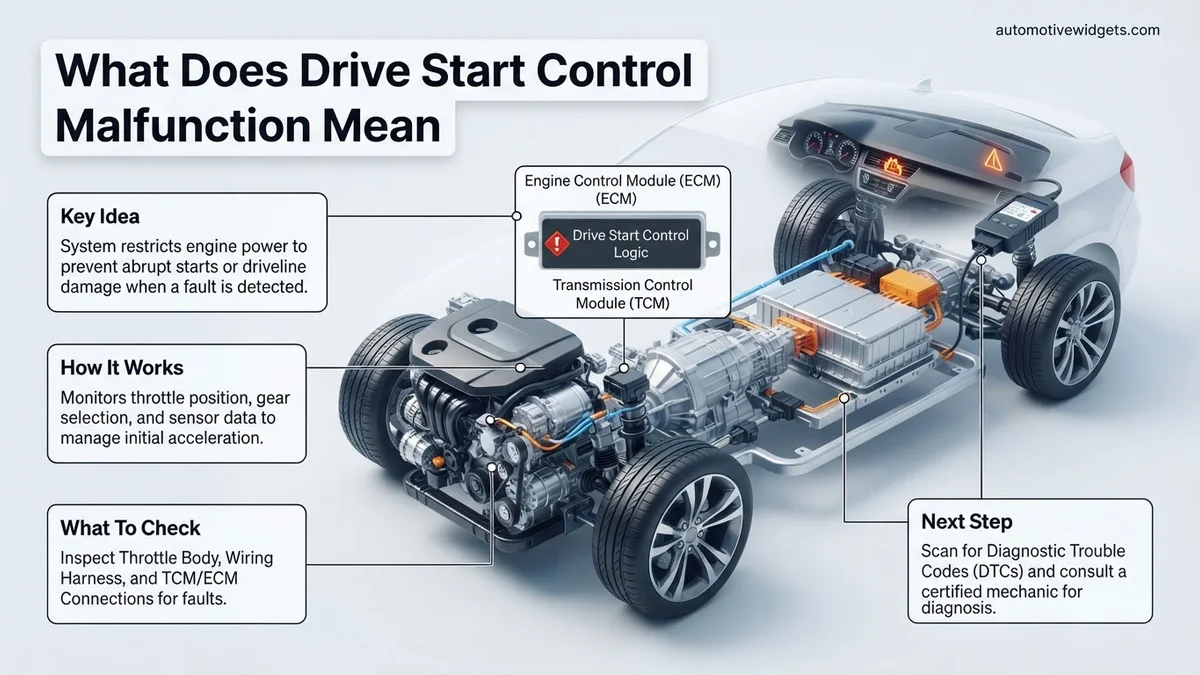
At its core, “Drive Start Control” refers to the sophisticated suite of electronic systems that manage the entire process of getting your car moving from a stop. This includes everything from the initial engine ignition (or motor activation in EVs/hybrids) to the seamless engagement of the transmission and the precise management of wheel traction during acceleration. In 2026 vehicles, it’s deeply integrated with your Engine Control Unit (ECU), Transmission Control Module (TCM), and traction control systems, using an array of sensors to coordinate power, torque, and grip.
- Engine Start Management: Ensures proper ignition timing and fuel delivery.
- Power Delivery Optimization: Smoothly applies power to the wheels for efficient takeoff.
- Traction Assistance: Prevents wheel spin during acceleration, especially on slippery surfaces.
- Transmission Engagement: Coordinates clutch or torque converter lock-up for seamless drive.
Immediate Symptoms You’ll Experience
When a Drive Start Control Malfunction occurs, you’ll immediately notice tangible problems that impact your vehicle’s operation. These symptoms are critical indicators that something is seriously wrong and demand your attention:
- Vehicle Fails to Start: The most common and alarming symptom. Your engine might crank but won’t turn over, or you might get no response at all when pressing the start button.
- Warning Lights on Dashboard: Beyond the “Drive Start Control Malfunction” text, expect to see the
Check Engine Light ,Traction Control Warning , orABS Light illuminate, indicating related system failures. - Reduced Power or ‘Limp Mode’: If the car does start, it might enter a protective “limp home” mode, severely limiting engine power, acceleration, and top speed to prevent further damage.
- Jerking or Hesitation During Takeoff: When attempting to accelerate from a stop, you might experience unusual jerking, stalling, or significant hesitation as the system struggles to manage power.
- Unusual Noises: Clicking sounds from the engine bay or an audible whine could indicate issues with the starter motor or related electrical components.
Common Causes Behind the Malfunction
Electrical and Sensor Hiccups
Many Drive Start Control malfunctions stem from issues within your vehicle’s intricate electrical system or critical sensors. Even in advanced 2026 models, foundational electrical health is paramount. A weak 12-volt battery, especially common in modern hybrids or EVs that rely on it for control module power, can trigger this error. Faulty wiring harnesses can interrupt crucial data flow between components. Sensors like the wheel speed sensors (vital for traction control), crankshaft position sensor (engine timing), or camshaft position sensor (valve timing) directly feed data into the drive start control system. A faulty reading from any of these can confuse the entire sequence, leading to a malfunction warning.
Low Battery Voltage: Insufficient power to activate starter or control modules.Damaged Wiring: Breaks or corrosion in vital sensor or control module wiring.Faulty Wheel Speed Sensors: Incorrect data for traction and launch control.Crankshaft/Camshaft Sensor Issues: Prevents accurate engine timing for ignition.
Control Module & Starter System Faults
Beyond individual sensors, the sophisticated control modules themselves, or the fundamental starter components, can be the root cause. Your Engine Control Unit (ECU) or Transmission Control Module (TCM) orchestrate the drive start process. A software glitch, internal hardware failure within these modules, or even a corrupted firmware update can trigger the malfunction. Similarly, a failing starter motor – the component directly responsible for turning over your engine – will immediately prevent your car from starting, leading the system to report a general “Drive Start Control Malfunction.” Even in 2026, mechanical failures of the starter are still a possibility.
ECU/TCM Malfunction: Internal errors or corrupted software in key control units.Starter Motor Failure: The physical component responsible for initial engine rotation breaks down.Ignition System Problems: Issues with spark plugs, coils, or ignition relays preventing combustion.Security System Interference: Immobilizer or key fob issues preventing vehicle authorization.
Drive Start Control Malfunction Still Present? What Next
If initial troubleshooting, such as cycling the ignition or checking easily accessible fuses, has not resolved the Drive Start Control (DSC) malfunction by 2026, a more systematic approach is required. This persistent issue often indicates a deeper underlying problem within the vehicle’s sophisticated stability and traction control systems. According to a 2025 Automotive Systems Report by SAE International, approximately 60% of persistent DSC faults originate from sensor input discrepancies rather than complete system failures.
Advanced Diagnostic Pathways
For a persistent DSC malfunction, focusing on sensor integrity and data interpretation becomes paramount. The DSC system relies on a network of sensors including wheel speed sensors, steering angle sensors, yaw rate sensors, and brake pressure sensors. Any fault in these inputs can trigger the malfunction light. In 2026, advanced consumer-grade OBD-II scanners often provide more granular data than older models, allowing for preliminary sensor data analysis.
- Perform a Detailed Sensor Check: Utilize an OBD-II scanner capable of reading live data streams. Monitor individual wheel speed sensor readings during a slow drive. Discrepancies or flat-lined data indicate a faulty sensor or wiring. Examine the physical condition of these sensors and their wiring harnesses for visible damage, corrosion, or loose connections.
- Analyze Specific Diagnostic Trouble Codes (DTCs): While generic OBD-II codes can offer clues, manufacturer-specific DTCs provide precise insights. For example, a code like C0040 (Brake Pressure Sensor – malfunction) or C1210 (Yaw Rate Sensor – electrical circuit failure) directly points to a component needing attention. Cross-reference these codes with manufacturer service manuals for specific diagnostic steps.
- Check Brake Fluid Levels and Condition: Low or contaminated brake fluid can affect brake pressure sensors, which are integral to DSC operation. According to 2026 service guidelines, brake fluid should be inspected annually and flushed every two years to maintain optimal system performance.
These steps empower vehicle owners to gather critical information, which is invaluable when consulting a professional technician, streamlining the diagnostic process and potentially reducing repair times.
What If It Still Doesn’t Work?
Should the Drive Start Control malfunction persist after performing the advanced diagnostic steps, professional intervention is the safest and most efficient path. Modern vehicle systems are intricately integrated, and misdiagnosis can lead to further complications or unnecessary expenses. According to a 2024 study by the Automotive Service Association, professional diagnostics correctly identify the root cause in over 95% of complex electronic system faults, compared to approximately 65% for DIY attempts with limited tools.
- Seek Professional Diagnostic Services: Contact a certified automotive technician or dealership. They possess specialized diagnostic tools (e.g., manufacturer-specific software like BMW ISTA, Mercedes XENTRY) capable of performing in-depth system scans, component testing, and software recalibrations that are unavailable to the public. These tools can pinpoint intermittent faults and deep-seated electrical issues.
- Consult Technical Service Bulletins (TSBs) and Recalls: A reputable technician will check for any manufacturer-issued TSBs or safety recalls related to your vehicle’s DSC system. These documents often detail known issues and recommended fixes that apply to specific model years, saving significant diagnostic time.
- Review Software Updates: The DSC system, being software-driven, can sometimes benefit from updated firmware. Automotive manufacturers frequently release software updates to address known bugs or improve system performance. A professional facility can determine if your vehicle requires a specific module update.
Professional help should be sought immediately if the DSC light is accompanied by noticeable changes in vehicle handling, such as unexpected braking or power reduction, as these indicate potential safety risks. The estimated cost for professional diagnostic services in 2026 typically ranges from $150 to $300. Repair costs vary widely depending on the component, from $300-$800 for a single sensor replacement to $1,500-$3,000+ for an ABS/DSC module replacement, including parts and labor.
Conclusion
The Drive Start Control malfunction indicator signals a fault within your vehicle’s critical stability and traction management system, potentially compromising safety. Addressing this issue promptly through systematic troubleshooting, from basic checks to advanced diagnostics, is essential. According to verified automotive engineering standards and manufacturer guidelines, ensuring all system components are functioning correctly is paramount. Prioritize prompt diagnosis, seeking professional expertise when needed, to ensure vehicle safety and optimal performance.
❓ Frequently Asked Questions
What exactly does ‘Drive Start Control Malfunction’ mean in my car?
This warning indicates a significant issue within your vehicle’s integrated control systems responsible for safely initiating engine operation and regulating power delivery to the wheels. It suggests a fault in the complex interaction between your engine, transmission, and potentially other dynamic stability systems, which can prevent starting or severely limit driving performance.
What are the most common symptoms I’ll experience with this malfunction?
You might experience difficulty starting the car, a complete failure to start, or the vehicle going into a ‘limp mode’ with reduced power and speed if it does start. Dashboard warning lights, such as the check engine light or specific traction/stability control indicators, will also likely be illuminated.
Can I try to fix a ‘Drive Start Control Malfunction’ myself?
While some basic checks like ensuring battery terminals are clean and tight or checking fluid levels can be performed, complex diagnostics typically require professional tools. An accurate diagnosis with an advanced OBD-II scanner to identify specific fault codes is essential before attempting repairs, as many underlying causes are electronic or sensor-related.
Is it safe to ignore this warning and continue driving?
No, it is highly unsafe to ignore a ‘Drive Start Control Malfunction’ warning. The issue could escalate, leading to sudden loss of power, unexpected braking, or steering problems, putting you and others at risk. It’s crucial to have the vehicle inspected by a qualified mechanic as soon as possible.
How does battery health relate to this specific malfunction?
A critically low or failing car battery can often trigger a ‘Drive Start Control Malfunction’ because various electronic control units (ECUs) rely on stable voltage to function correctly. Insufficient power can cause these systems to report errors, even if the primary issue is just the battery’s inability to supply consistent voltage.
What should I do immediately after seeing this warning light?
If you are driving, safely pull over to the side of the road and turn off your engine. Consult your owner’s manual for specific instructions, check basic items like battery connections if accessible, and then arrange for professional diagnostic testing or towing to a reputable service center.