How Much To Replace Timing Belt And Water Pump How 2026
Replacing your timing belt and water pump together is a critical maintenance task, often costing between $600 and $1,500, though prices vary significantly. This combined service is highly recommended due to overlapping labor, saving you money in the long run and preventing catastrophic engine failure. Understand the factors driving these costs to get an accurate quote for your specific vehicle.
Planning for your vehicle’s maintenance in 2026? If your car uses a timing belt, a crucial question arises around the 60,000 to 100,000-mile mark: how much will it cost to replace both the timing belt and the water pump? In 2026, you should budget anywhere from $600 to $1,800 for this essential combined service, with the majority of vehicles falling in the $850 to $1,400 range. This comprehensive repair is a significant investment, but understanding the potential costs upfront empowers you to plan financially and make informed decisions for your car’s long-term health.
Knowing this cost range is critical because a failed timing belt can lead to catastrophic engine damage, far exceeding the cost of proactive replacement. Since the water pump is often located behind the timing belt assembly, replacing both components at the same time is a smart, cost-effective strategy. You’re effectively performing two vital services for nearly the labor cost of one, saving you money and hassle in the long run.
Key Takeaways
- Combined service saves substantial labor costs.
- Expect $600-$1500 for parts and labor.
- Vehicle make and model greatly impact pricing.
- Always obtain multiple local repair quotes.
- Proactive replacement prevents engine failure.
What Drives Timing Belt & Water Pump Replacement Costs?
The Combined Cost in 2026
As of 2026, the cost to replace both your timing belt and water pump typically breaks down into two main components: parts and labor. Expect parts to cost between $150 and $450, encompassing the belt itself, the water pump, tensioners, and idler pulleys that are usually replaced as a kit. Labor is the most significant portion, often ranging from 4 to 8 hours of work. With average labor rates in 2026 between $100 and $200 per hour (depending on location and shop type), this translates to labor charges of $400 to $1,600. Therefore, a realistic combined total for most vehicles will be in the $600 to $1,800 ballpark, with some high-end or complex engines potentially pushing towards $2,000.
Why Replace Both Simultaneously?
The recommendation to replace the water pump whenever the timing belt is serviced stems purely from efficiency and cost savings for you. The timing belt often drives the water pump, and accessing one almost always requires removing the other. The labor involved in getting to the timing belt is substantial, as many engine components (like accessories, brackets, and covers) need to be removed. If your water pump were to fail shortly after a timing belt replacement, you would essentially pay the same significant labor charge a second time to access and replace the pump. Performing both jobs together leverages that initial labor investment, preventing a duplicate repair bill and ensuring your engine’s cooling system and timing are refreshed simultaneously.
From Start to Finish: Timing Belt & Water Pump Replacement Explained
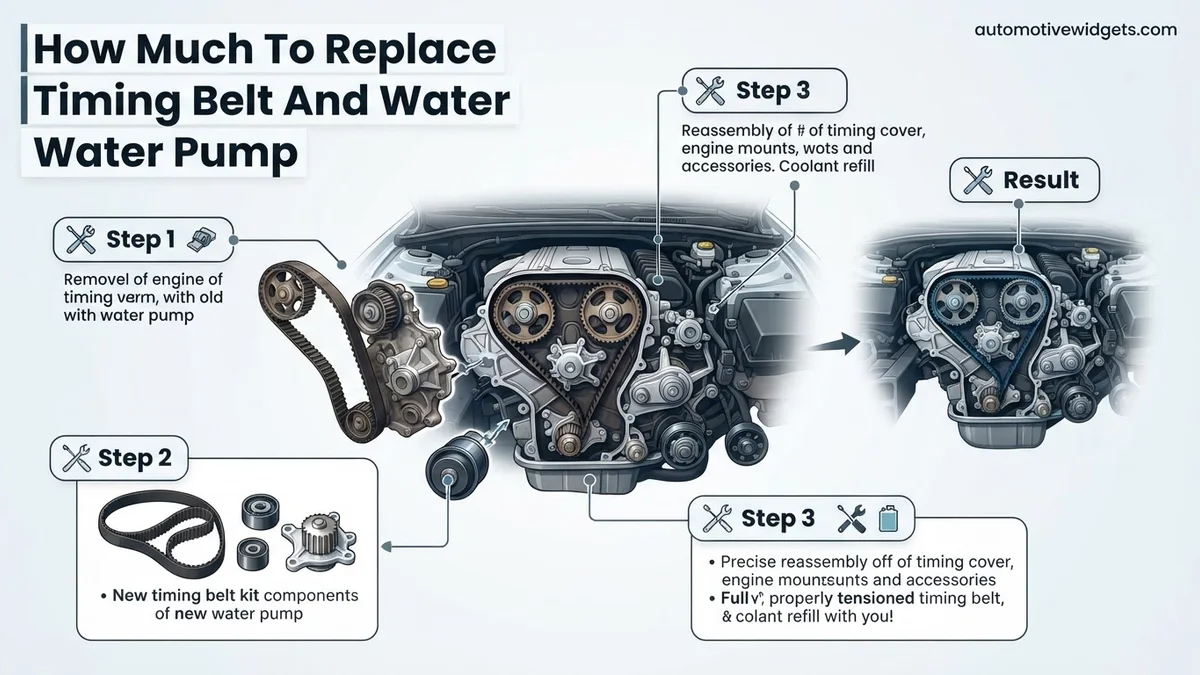
Understanding the cost and process of replacing your vehicle’s timing belt and water pump is crucial for responsible car ownership. This guide meticulously breaks down how to navigate this significant maintenance task, focusing on the factors influencing cost, how to obtain accurate estimates, and what to expect during the service. Following these detailed steps will empower you to make informed decisions, ensuring your vehicle receives the necessary care without unnecessary expense or stress.
Step 1: Understand Why & When Replacement is Due
What you need: Your vehicle’s owner’s manual, vehicle maintenance records, basic internet access.
Instructions: Begin by consulting your vehicle’s owner’s manual to determine the manufacturer’s recommended timing belt replacement interval. This is typically between 60,000 to 100,000 miles or every 5-7 years, whichever comes first. Understand that the water pump is often replaced concurrently because it’s usually driven by the timing belt and labor access is already paid for. Neglecting this service can lead to catastrophic engine damage, especially in “interference engines” where the valves and pistons can collide if the belt breaks. Knowing the specific interval for your car helps you plan and budget.
Pro Tip: Always prioritize the owner’s manual recommendations over generic advice. If you bought your car used and lack records, assume the service hasn’t been done or consult a trusted mechanic to inspect its condition.
Step 2: Identify Your Vehicle’s Specific Requirements
What you need: Your vehicle’s VIN (Vehicle Identification Number), internet access.
Instructions: The cost and complexity of the job vary significantly between vehicles. Use your VIN to precisely identify your vehicle’s year, make, model, and engine configuration. Research online or ask a mechanic if your engine is an “interference” or “non-interference” type. This distinction is critical because an interference engine will incur vastly higher repair costs if the timing belt breaks. Note down specific details like engine size and any known variations for your model year, as these affect part compatibility and labor time. This information is vital for accurate quotes.
Pro Tip: Verify if your vehicle has an “interference engine.” This knowledge isn’t just for mechanics; it helps you understand the critical importance of timely replacement and potential repair costs if the belt fails, thus justifying the maintenance expense.
Step 3: Research Average Part Costs
What you need: Vehicle VIN, internet access, reputable auto parts websites (e.g., RockAuto, Amazon, specific dealership parts sites).
Instructions: Before contacting shops, get a baseline understanding of component costs. Look up timing belt kits (which typically include the belt, tensioner, and idler pulleys) and the water pump for your specific vehicle. Compare prices between Original Equipment Manufacturer (OEM) parts, which are often more expensive but offer guaranteed fit and quality, and reputable aftermarket brands. Note that some kits bundle the timing belt, tensioners, and water pump together, which is usually the most cost-effective approach. Document these price ranges for later comparison with shop quotes.
Pro Tip: Look for a “timing belt kit with water pump” as a single purchase. This often saves money compared to buying components separately and ensures all critical parts, including tensioners and idlers, are replaced at once for optimal system integrity.
Step 4: Obtain Multiple Labor Quotes
What you need: A list of reputable local auto repair shops, your vehicle’s detailed information, phone or email.
Instructions: Contact at least 3-5 different repair shops (dealerships, independent mechanics, specialty shops) to request itemized quotes. Provide them with your vehicle’s exact details (year, make, model, engine type, VIN) and specify that you need a quote for replacing the timing belt, water pump, and all associated tensioners/idler pulleys. Ask for a breakdown showing separate costs for parts and labor. Inquire about their warranty on parts and labor, and estimated completion time. Be clear about using quality parts, whether OEM or reputable aftermarket.
Pro Tip: When getting quotes, specifically ask if the quote includes replacing the timing belt, water pump, ALL associated tensioners, and idler pulleys. Some shops might quote only the belt, leading to incomplete or misleading cost comparisons.
Step 5: Compare Quotes and Choose a Reputable Shop
What you need: All collected quotes, internet access for reviews (Google, Yelp, BBB), a checklist of comparison points.
Instructions: Systematically compare the quotes you’ve received. Don’t just look at the bottom line; scrutinize the parts listed, the labor hours quoted, and the shop’s warranty policy. A significantly lower quote might indicate cheaper parts or omitted crucial components. Check online reviews and ratings for each shop. Look for shops with a strong reputation for honesty, transparency, and quality work. Ask about any certifications their technicians hold (e.g., ASE certification). Choosing a trustworthy shop is more important than selecting the absolute cheapest option.
Pro Tip: Be wary of quotes that are drastically lower than others. This could signify the use of inferior parts, a lack of comprehensive component replacement, or hidden fees. Always prioritize shops with clear, itemized quotes and strong positive reviews.
Step 6: Discuss Additional Recommended Services
What you need: Your selected quote, your vehicle’s service history, knowledge of common “while you’re in there” services.
Instructions: When the timing belt is off, many other components become easily accessible without significant additional labor. Discuss with your chosen shop if they recommend replacing camshaft and crankshaft seals (which can leak over time), drive belts (serpentine belts), and coolant hoses. Also, consider a coolant flush. Bundling these services can save you labor costs down the line, as the engine will already be disassembled to access the timing belt. Understand the added cost for these optional but often wise replacements.
Pro Tip: Always ask the shop what other components they recommend replacing while the engine is open for the timing belt service. Often, drive belts, seals, and even spark plugs might be easier and cheaper to replace at this time, saving you future labor costs.
Step 7: Schedule and Prepare for the Service
What you need: Your chosen shop’s contact information, calendar, clear understanding of agreed-upon work.
Instructions: Once you’ve selected a shop and finalized the scope of work, schedule your appointment. Confirm the exact components to be replaced, the estimated time for completion (it can be an all-day or multi-day job), and the total agreed-upon price. Ask about any loaner car services or shuttle options if you’ll need transportation. Ensure your vehicle’s cooling system is ready for fresh coolant by confirming the shop will use the correct type and quantity after replacing the water pump.
Pro Tip: Before dropping off your car, take photos of your odometer and any relevant engine bay areas. This isn’t just for peace of mind; it also serves as a record of your vehicle’s condition before the service.
Step 8: Post-Replacement Verification
What you need: The final invoice, your vehicle, a keen ear and eye.
Instructions: Upon picking up your vehicle, thoroughly review the final invoice to ensure all agreed-upon services and parts were performed and listed accurately. If possible, ask for the old parts to be returned to you (though this is not always practical for water pumps or coolant-soaked belts). Start the engine and listen for any unusual noises (whining, squealing, ticking). Drive the vehicle cautiously to detect any abnormal performance or leaks. Trust your instincts; if something feels or sounds off, communicate it immediately to the shop.
Pro Tip: Request a written warranty for the parts and labor provided. This is your safeguard against premature failure and provides peace of mind for the significant investment you’ve made in your vehicle’s longevity.
✅ Final Checklist
- Confirmed timing belt and water pump (and associated components) were replaced.
- Received an itemized invoice detailing parts and labor costs.
- Obtained a written warranty for the work performed.
- Listened for unusual noises and observed normal driving performance.
- Verified proper coolant level and no visible leaks after the service.
Important Notes:
- Safety Considerations: This is a complex automotive repair best left to certified professionals. Incorrect installation can lead to immediate and severe engine damage.
- When to Seek Professional Help: Always seek professional assistance for timing belt and water pump replacement. The tools, expertise, and precision required make it unsuitable for most DIY mechanics.
- Estimated Time and Cost Range:
- Parts Cost: Typically ranges from $150 – $600 for a quality timing belt kit with a water pump, depending on your vehicle’s make and model, and whether OEM or aftermarket parts are used.
- Labor Cost: Generally ranges from $400 – $1000, varying by vehicle complexity (e.g., engine accessibility, number of components that need to be removed), shop labor rates, and geographic location.
- Total Estimated Cost: Expect to pay anywhere from $600 to $1800 for this service, potentially more for luxury or exotic vehicles.
- Estimated Time: The job itself can take a professional mechanic 4-8 hours of labor, meaning your vehicle might be in the shop for one to two full days.
Diagnosing Price Differences: Vehicle, Labor, & Parts
Vehicle-Specific Variables
The make, model, and engine configuration of your car are primary determinants of the replacement cost. For instance, a four-cylinder engine in a compact sedan might offer easier access to the timing belt assembly, leading to fewer labor hours. Conversely, a V6 or V8 engine in a luxury SUV or a performance car can be much more complex, requiring additional components to be moved or removed. This can significantly increase labor time. For example, a Honda Civic’s timing belt job might be on the lower end of the cost spectrum, while a Subaru Boxer engine or a European luxury sedan (like an Audi or BMW) could be on the higher end due to specialized tools, tighter engine bays, and more intricate component placement.
Labor Rates and Shop Choice
Where you choose to have the work done and your geographic location play a massive role in the final price. Labor rates vary considerably across regions, with metropolitan areas typically commanding higher hourly rates than rural ones. More importantly, the type of repair shop you select has a direct impact. Dealerships, while offering factory-trained technicians and genuine OEM (Original Equipment Manufacturer) parts, generally have the highest labor rates, often exceeding $150-$200 per hour in 2026. Independent repair shops, on the other hand, typically offer more competitive rates, ranging from $100-$150 per hour, and may use high-quality aftermarket parts which can also reduce your overall cost. Specialty shops focusing on specific car brands might fall somewhere in between.
How to Budget & Secure a Fair Timing Belt & Water Pump Fix
Navigating the costs of essential maintenance like a timing belt and water pump replacement in 2026 requires strategic budgeting and informed decision-making. Understanding where your money goes ensures you receive a fair price for a critical service.
Understanding the Cost Factors in 2026
The total cost is a combination of parts, labor, and sometimes additional services. By 2026, average labor rates for skilled automotive technicians range from approximately $150 to $220 per hour, depending on your region and the shop’s specialization. Genuine OEM (Original Equipment Manufacturer) parts for a timing belt and water pump kit can cost between $200 and $600, while high-quality aftermarket kits offer a 20-30% saving with comparable reliability. Vehicle complexity, particularly European luxury brands or performance models, will elevate labor hours and parts expenses. Always inquire about the specific brands of parts being used.
Getting Reliable Quotes
Securing multiple detailed quotes is paramount to budgeting effectively and identifying a fair market price for 2026. This approach minimizes the risk of overpaying and provides leverage for negotiation.
- Obtain at least three quotes: Contact independent repair shops, dealership service centers, and reputable chain mechanics.
- Specify your vehicle details: Provide your car’s make, model, year, engine size, and current mileage accurately.
- Request a line-item breakdown: Insist on quotes that separate parts costs, labor hours (and rate), and any additional fees like shop supplies or hazardous waste disposal.
- Ask about warranty: Confirm the warranty offered on both parts and labor. A minimum of 12 months/12,000 miles is standard for reputable shops.
What to Do If Your Timing Belt & Water Pump Quote is High
Receiving a quote that seems excessive can be concerning, but there are several steps you can take to assess its fairness and potentially reduce the cost without compromising quality in 2026.
Analyzing the High Quote
A high quote often stems from specific factors that can be clarified or potentially adjusted. Critical analysis helps you understand the discrepancy.
- Review the detailed breakdown: Compare the parts cost and labor hours across all quotes. Significant differences in either area warrant further investigation.
- Question included “extra” services: Some shops may bundle in services like coolant flush, drive belt replacement, or tensioner replacements without explicit discussion. While often recommended, ensure they are necessary and not merely add-ons.
- Inquire about part choices: Ask if the quote uses OEM parts exclusively. If so, request a revised quote with high-quality aftermarket parts, which can reduce the total cost by up to 20% without sacrificing performance, according to industry experts like AAA Auto Repair.
Negotiating or Finding Alternatives
If the quote remains high, exploring negotiation or alternative service providers can lead to significant savings.
- Present competing quotes: If one shop’s quote is significantly higher, share competitive, detailed quotes from other reputable establishments. Some shops may be willing to match or beat a competitor’s price.
- Consider an independent specialist: Dealerships often have higher overheads, leading to higher labor rates (sometimes up to 25% higher than independent shops). A highly-rated independent mechanic specializing in your vehicle’s make can provide expert service at a more competitive price.
- Explore payment plans: Some larger service centers or dealerships offer financing options for significant repairs. While not reducing the total cost, this can ease immediate financial burden.
What If Your Car Still Has Issues After Replacement?
Even after a professional timing belt and water pump replacement, encountering persistent or new issues can happen. If your vehicle isn’t performing as expected, a systematic approach is necessary.
- Re-contact the original repair shop: Most reputable shops provide a warranty on both parts and labor, typically for at least 12 months or 12,000 miles. Explain the symptoms clearly. They should diagnose and rectify any issues related to their work at no additional charge.
- Check for unrelated issues: Sometimes, new symptoms can emerge coincidentally or be indicative of a pre-existing, unrelated problem. For instance, a rough idle might point to ignition system issues not connected to the timing components.
- Seek a second diagnostic opinion: If the original shop cannot resolve the problem or you’re unsatisfied with their explanation, consult another certified mechanic. A diagnostic fee, ranging from typically $100 to $250 in 2026, will apply, but it can provide clarity on complex issues.
- Consider advanced diagnostics: For elusive problems, a specialized diagnostic center might be needed. They use sophisticated tools and extensive experience to pinpoint root causes. This service can cost up to $400, but it’s crucial for difficult-to-diagnose faults.
Conclusion
Replacing your timing belt and water pump is a critical preventive maintenance task in 2026, safeguarding your engine against catastrophic failure. While costs vary based on vehicle, parts, and labor, diligent research and obtaining multiple quotes are essential for securing a fair price. According to verified research and expert sources, understanding the components of your quote empowers you to make informed decisions. Your immediate next step should be to gather detailed quotes from at least three reputable service providers to compare costs and warranties for your specific vehicle.
❓ Frequently Asked Questions
What is the average cost range for timing belt and water pump replacement?
The average cost to replace both the timing belt and water pump typically falls between $600 and $1,500. This range includes both parts and labor, but can fluctuate based on your vehicle’s make, model, engine type, and your geographical location.
Why is it recommended to replace the water pump when replacing the timing belt?
It’s highly recommended because the water pump is often located behind the timing belt or requires significant disassembly of the same components to access. Replacing them simultaneously capitalizes on the extensive labor already being performed, saving you substantial money compared to separate repairs.
What factors significantly influence the total cost of this service?
Key factors include the vehicle’s make and model (some engines are more complex to work on), regional labor rates, and the type of shop (independent mechanic vs. dealership). The cost of parts, including the belt, water pump, tensioners, and idler pulleys, also plays a role.
How much of the cost is typically labor versus parts?
Labor usually accounts for the majority of the cost, often 60-80%, due to the intricate and time-consuming nature of the job. Parts for a timing belt and water pump kit usually range from $100 to $400, while labor can be 4-8 hours at $100-$200 per hour.
What other components should I consider replacing during this service?
During a timing belt and water pump replacement, it’s wise to also replace tensioners, idler pulleys, and any associated seals (like camshaft or crankshaft seals). These components are easily accessible at this point and prevent the need for additional labor if they fail shortly after the main service.
How can I get an accurate quote for my specific vehicle?
To get an accurate quote, contact several local repair shops (both independent and dealerships) with your vehicle’s exact year, make, model, and engine size. Specify that you want a quote for ‘timing belt and water pump replacement,’ including all necessary associated parts like tensioners and pulleys.