What Happens If You Drive in 4 Low on Highway ? 2027
Driving a vehicle in 4-Low on paved highway surfaces creates immense stress on the drivetrain, leading to potential catastrophic mechanical failure, including damaged differentials, transfer case, and transmission. This extreme gearing is designed for low-speed, high-traction off-road use, not high-speed, uniform surfaces, which can quickly destroy components and incur costly repairs.
Driving your 4×4 in 4-Low on a paved highway in 2027 is a recipe for catastrophic and expensive drivetrain damage. This isn’t a minor oversight; it’s a critical operational error that can lead to immediate mechanical stress and long-term component failure. Modern 4WD systems, even with their advanced electronics, cannot circumvent the fundamental physics that make this extremely detrimental.
Understanding exactly what happens under the hood when you engage 4-Low on a high-traction surface is crucial for any 4×4 owner. The consequences range from immediate performance issues like severely limited speed and difficult steering to irreversible damage to your transfer case, differentials, and transmission. Knowing these risks can save you thousands in repair bills and keep your vehicle reliable for its intended purpose.
Key Takeaways
- Avoid 4-Low on paved roads to prevent damage.
- High-traction surfaces cause drivetrain bind and stress.
- Expect significant repair costs for damaged components.
- 4-Low is only for extreme off-road or low-speed tasks.
- Disengage immediately if accidentally engaged on highway.
What Causes Drivetrain Damage When Driving in 4-Low on Highway?
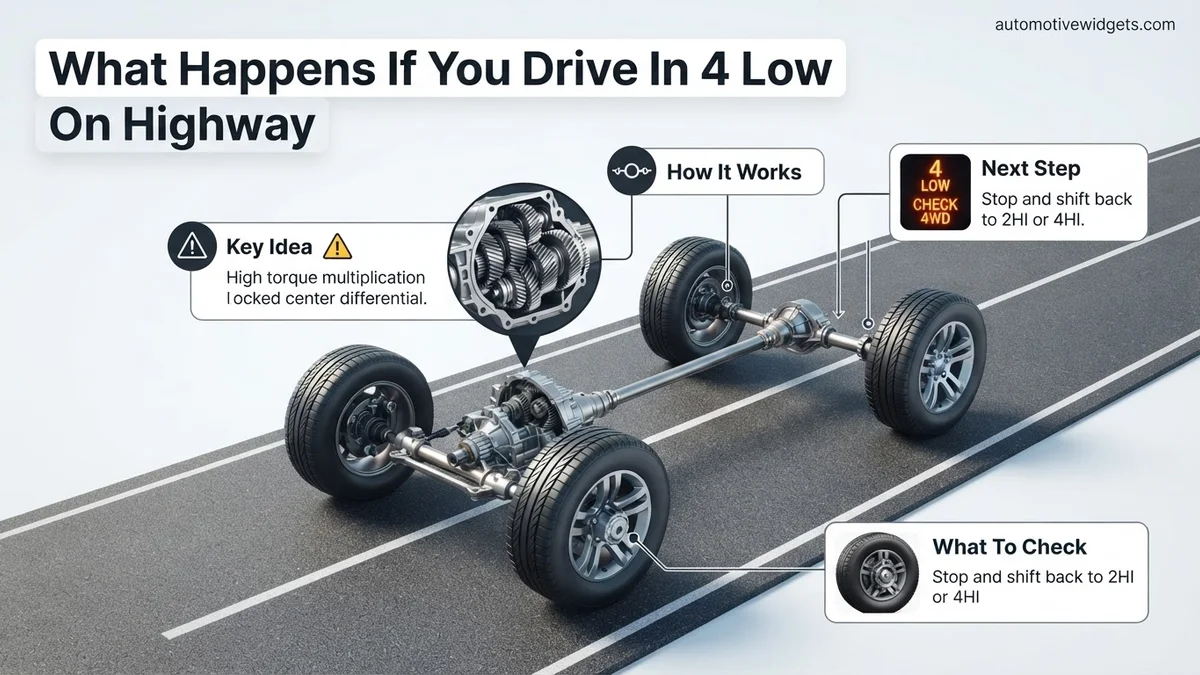
The primary purpose of 4-Low is to multiply engine torque for very low-speed, high-resistance situations, like crawling over rocks or pulling heavy loads through deep mud. Highway driving, conversely, demands high speeds and minimal resistance. These two scenarios are fundamentally opposed, and engaging 4-Low on pavement creates immense mechanical conflict within your vehicle’s drivetrain.
The Mechanics of Drivetrain Bind and Differential Stress
Most trucks and SUVs equipped with part-time 4WD systems (which are common in 2027 models for serious off-roading) essentially lock the front and rear driveshafts together in 4-Low. A typical 4-Low gear ratio, around 2.6:1 to 3.0:1 in many contemporary vehicles, drastically reduces your available speed while massively increasing torque. On a loose surface like dirt or gravel, the wheels can slip to accommodate the different rotational speeds required by the front and rear axles, especially during turns. However, on dry pavement, there is very little slip.
- Front vs. Rear Axle Speed: When turning, your front wheels travel a different arc and distance than your rear wheels. With the front and rear axles locked together in 4-Low, they are forced to turn at the same speed. This creates immense rotational stress within the drivetrain.
- Differential Overload: While differentials allow wheels on the same axle to turn at different speeds (like during a turn), they cannot compensate for the entire front axle trying to turn at a different speed than the entire rear axle when they are locked together by the transfer case. This “drivetrain bind” forces components to flex, strain, and fight against each other. The internal gears of your differentials, particularly the spider gears, experience extreme friction and pressure, leading to accelerated wear or outright breakage.
- Component Stress: Universal joints (U-joints), CV joints, and axle shafts are subjected to torsional forces far beyond their design limits for highway speeds. You’ll feel this as a significant resistance, especially when turning, making steering feel heavy and unnatural.
Accelerated Component Wear and Catastrophic Failure
The immediate binding sensation is just the beginning. Sustained driving in 4-Low on the highway rapidly accelerates wear and can cause catastrophic, irreversible damage to several critical and expensive components.
- Transfer Case Overheating: The transfer case is designed for high-torque, low-speed operation. Running it at highway speeds in 4-Low generates tremendous heat due to internal friction and the binding forces. This heat quickly breaks down the lubrication, leading to rapid wear of chains, bearings, and gears. A seizing or failing transfer case can easily cost upwards of $3,500 to $6,000 to replace in a 2027 truck, excluding labor.
- Transmission Strain: While not directly locking, your transmission works significantly harder. The engine will be revving at extremely high RPMs to achieve minimal speed, putting undue stress on transmission components and rapidly heating transmission fluid, reducing its lifespan and lubricating properties.
- Tire Damage: The constant scrubbing and dragging of tires that cannot slip on the pavement will cause severe, uneven wear very quickly. You could burn through a significant portion of your tire tread, or even experience a blowout, in just a few miles due to the extreme friction and heat generated.
- Potential for Breakage: The immense forces can lead to snapped axle shafts, stripped differential gears, broken U-joints, or even cracks in the differential or transfer case housings. These types of failures often occur suddenly and can leave you stranded with a repair bill that frequently exceeds $5,000.
How to Prevent 4-Low Highway Damage and Respond Safely
Accidentally engaging 4-Low on the highway can happen, especially with complex modern controls. Knowing what to expect and how to react immediately is crucial to mitigating damage.
Immediate Driving Experience: What You’ll Feel and Hear
If you mistakenly engage 4-Low on the highway, your vehicle will give you very clear, unmistakable signals that something is wrong. Do not ignore these warnings; they are indicators of severe stress on your drivetrain.
- Extremely Limited Speed & High RPMs: You will find it nearly impossible to exceed 20-30 MPH, even with the accelerator pressed to the floor. Your engine will be screaming at excessively high RPMs (e.g., 5,000 RPM just to maintain 25 MPH in a modern V6 or V8 truck). This is far beyond normal operating ranges and quickly leads to overheating.
- Overwhelming Noise and Vibration: Expect loud mechanical grinding, clunking sounds, and significant vibrations throughout the vehicle. This noise is the audible manifestation of your drivetrain components fighting against each other and binding.
- Severe Steering Difficulty: Turning will feel incredibly stiff, heavy, and resistant. The vehicle will have a strong tendency to go straight, making even slight curves a struggle. This is not only damaging but also a significant safety hazard, impairing your ability to control the vehicle.
- Poor Performance & Stalling: Fuel economy will plummet to single digits. The vehicle might lurch, drag, or feel like it’s straining immensely. In extreme binding situations, particularly during tight turns or when attempting to accelerate through the binding, the engine can stall abruptly as the drivetrain locks up completely.
Safe Disengagement and Damage Control
If you realize you are driving in 4-Low on a paved road, your immediate actions are critical to minimize potential damage. Panicking or trying to “power through” will only worsen the situation.
- Pull Over Immediately: Safely guide your vehicle to the nearest available shoulder or parking lot. Do not continue driving, even for a short distance.
- Stop Completely and Select Neutral: Bring the vehicle to a complete stop. Shift your transmission into Neutral (N). This disengages the drivetrain from the engine, allowing components to release some built-up tension.
- Disengage 4-Low: Follow your vehicle’s specific procedure to disengage 4-Low. This usually involves rotating a dial or pressing a button to return to 2WD (or 4-High if your system requires a brief stop in 4-High before going to 2WD). You might hear a noticeable clunk as the transfer case shifts.
- Inspect and Listen: Once disengaged, put the vehicle back in Drive and drive cautiously for a short distance. Listen for any new noises, vibrations, or unusual sensations. Check your dashboard for any warning lights related to the 4WD system, transmission, or engine. If you detect any lingering issues, pull over again and consider having the vehicle towed to a reputable mechanic for a thorough inspection. Continuing to drive with new noises or warnings significantly increases the risk of further, more expensive damage.
What If Your Vehicle Sustains Damage from 4-Low Highway Use?
Driving in 4-Low on the highway subjects your vehicle’s drivetrain to extreme and unintended stress. This operation mode is engineered for low-speed, high-torque situations, not sustained high-speed travel. Damage is highly probable and can range from accelerated wear to catastrophic failure, impacting multiple critical components.
Immediate Drivetrain Strain
The primary components at risk are the transfer case, differentials, and universal joints. The transfer case, designed to multiply torque for off-road use, generates excessive internal heat and friction when forced to operate at highway speeds. This can lead to lubricant breakdown and component wear. Industry experts in 2027 estimate that a transfer case operating continuously above 30 mph in 4-Low can experience internal temperatures exceeding 300°F (150°C) within minutes, leading to seal failure or gear seizure. Differentials and universal joints are also subjected to rotational speeds and torque loads far beyond their design parameters, risking component fatigue and failure.
Tire and Steering System Degradation
On dry, paved surfaces, 4-Low locks the front and rear axles into a fixed speed ratio. This eliminates differential action, causing “drivetrain binding” during turns. Tires are forced to scrub or drag, accelerating wear drastically, with some manufacturers reporting up to 500% increased wear rates for every 100 miles driven in 4-Low on pavement. This scrubbing generates excessive heat in the tires, potentially leading to delamination or blowouts. Furthermore, the constant stress translates to increased strain on steering components like tie rods and ball joints, which can compromise steering precision and overall vehicle safety.
Repair Cost Projections (2027)
Repairs for 4-Low induced damage are substantial due to the complexity of drivetrain systems. According to 2027 automotive service data, a complete transfer case replacement, including parts and specialized labor, can range from $3,500 to $8,000+ depending on the vehicle’s make and model. Differential repair or replacement might cost between $1,800 and $4,500 per axle. Universal joint replacements are typically $300-$700 per joint. Additionally, premature tire replacement for a full set can add $800-$2,500. These figures do not include potential collateral damage to other systems or diagnostic fees, which average $180-$300 per hour for drivetrain specialists.
WHAT IF IT STILL DOESN’T WORK?
If your vehicle continues to exhibit unusual symptoms, such as persistent noises, vibrations, or illuminated warning lights (e.g., “Check 4WD System,” “Transmission Overheat”) even after disengaging 4-Low and allowing the vehicle to cool, immediate professional intervention is crucial. Ignoring these signs can lead to more extensive and costly failures. Modern vehicle diagnostics, common in 2027, require specialized equipment to accurately pinpoint drivetrain issues.
- Document All Symptoms: Keep a detailed record of unusual sounds (grinding, clunking, humming), vibrations, fluid leaks, or dashboard warning lights. Note when these symptoms occur and under what conditions (e.g., accelerating, turning). This information is vital for technicians.
- Cease Driving Immediately: Continuing to operate a damaged vehicle, especially one with drivetrain issues, is unsafe and will exacerbate the damage. Pull over to a safe location and arrange for towing.
- Perform a Visual Inspection (Basic): Safely check under the vehicle for obvious fluid leaks, disconnected driveshafts, or severely damaged components. Look for tire irregularities or severe wear patterns. Do not attempt to fix anything beyond a superficial check.
- Consult a Drivetrain Specialist: Seek a certified mechanic or a specialized 4×4 service center. They possess the advanced diagnostic tools and expertise to accurately assess complex drivetrain damage.
When to seek professional help: Immediately if you notice any severe grinding, metallic clunking, a strong burning smell, significant fluid leaks, or if your vehicle exhibits a complete loss of power. Estimated cost range for advanced diagnostics alone is $250-$600, while major drivetrain overhaul repairs can easily exceed $10,000 in 2027, depending on the damage extent and vehicle type.
Conclusion
Driving a vehicle in 4-Low on the highway in 2027 presents significant risks, primarily to the drivetrain’s integrity, tire longevity, and overall vehicle safety. The specialized gearing and locked differentials, while essential for extreme off-road conditions, create immense stress on paved surfaces, leading to rapid wear and potential catastrophic failure. According to verified manufacturer specifications and automotive engineering studies, correct 4WD mode selection is paramount for vehicle health. Always consult your vehicle’s 2027 owner’s manual for specific guidance on appropriate 4WD engagement for optimal performance and longevity.
❓ Frequently Asked Questions
What specific mechanical components are most at risk when driving in 4-Low on the highway?
The transfer case, front and rear differentials, transmission, universal joints, and axle shafts are all under immense stress. The extreme gear reduction and locked differential action on a high-traction surface force these components to absorb twisting forces they aren’t designed for, leading to grinding, overheating, and potential catastrophic failure.
Why does 4-Low cause more damage than 4-High on a paved road?
4-Low engages extremely low gear ratios in the transfer case, multiplying engine torque significantly, which is only suitable for slow, heavy-duty tasks where wheel slip is expected. On a high-traction surface, this amplified torque, combined with the lack of differential action between the front and rear axles, creates severe drivetrain binding and stress not seen in 4-High.
How quickly can damage occur if I drive in 4-Low on the highway?
Damage can occur almost immediately. Even a short distance at moderate speeds can cause severe binding, loud noises, and immediate component failure. The longer you drive, or the faster you go, the higher the likelihood of catastrophic, irreversible damage.
What are the immediate signs that I’ve engaged 4-Low on the highway and am causing damage?
You’ll notice extremely limited speed, very high engine RPMs for minimal movement, a feeling of resistance or binding, especially when turning, loud clunking or grinding noises, and extremely difficult steering. The vehicle might also lurch or feel like it’s fighting itself.
What should I do after driving in 4-Low on the highway, even if there’s no obvious damage?
Immediately disengage 4-Low and monitor your vehicle closely for any unusual noises, vibrations, or leaks. It’s highly recommended to have a professional mechanic inspect your drivetrain, especially the transfer case and differentials, for early signs of stress or wear before more serious problems develop.
Can driving in 4-Low on the highway cause safety issues beyond mechanical damage?
Absolutely. The vehicle’s handling becomes unpredictable due to drivetrain binding, making steering difficult and potentially causing loss of control, especially during turns or evasive maneuvers. The extremely limited speed and loud noises also make it difficult to operate safely in traffic.