Why Did My Car Stop Accelerating While Driving? Real 2026
When your car suddenly stops accelerating while driving, it’s a critical safety issue demanding immediate attention. This often points to fuel delivery, air intake, ignition system failures, or your vehicle entering a protective ‘limp mode’ to prevent further damage.
When your car suddenly loses power and stops accelerating while you’re driving, it’s an alarming and potentially dangerous situation. This immediate loss of acceleration means your vehicle isn’t receiving the necessary fuel, air, or spark, or its powertrain is encountering a critical issue. Understanding the potential causes quickly, along with knowing the correct immediate actions to take, is crucial for your safety on the road in 2026 and for preventing more significant damage to your vehicle.
This isn’t just about identifying a problem; it’s about making informed decisions under pressure. Whether you’re on a busy highway or a quiet residential street, reacting correctly can prevent accidents and save you from more costly repairs down the line. We’ll outline the most common culprits behind this power loss and guide you through the essential steps to take when it happens.
Key Takeaways
- Safely pull over immediately if acceleration fails.
- Check dashboard warning lights for diagnostic clues.
- Common causes include fuel, air, ignition, and transmission issues.
- Limp mode protects the engine from severe damage.
- Professional diagnosis is crucial for complex problems.
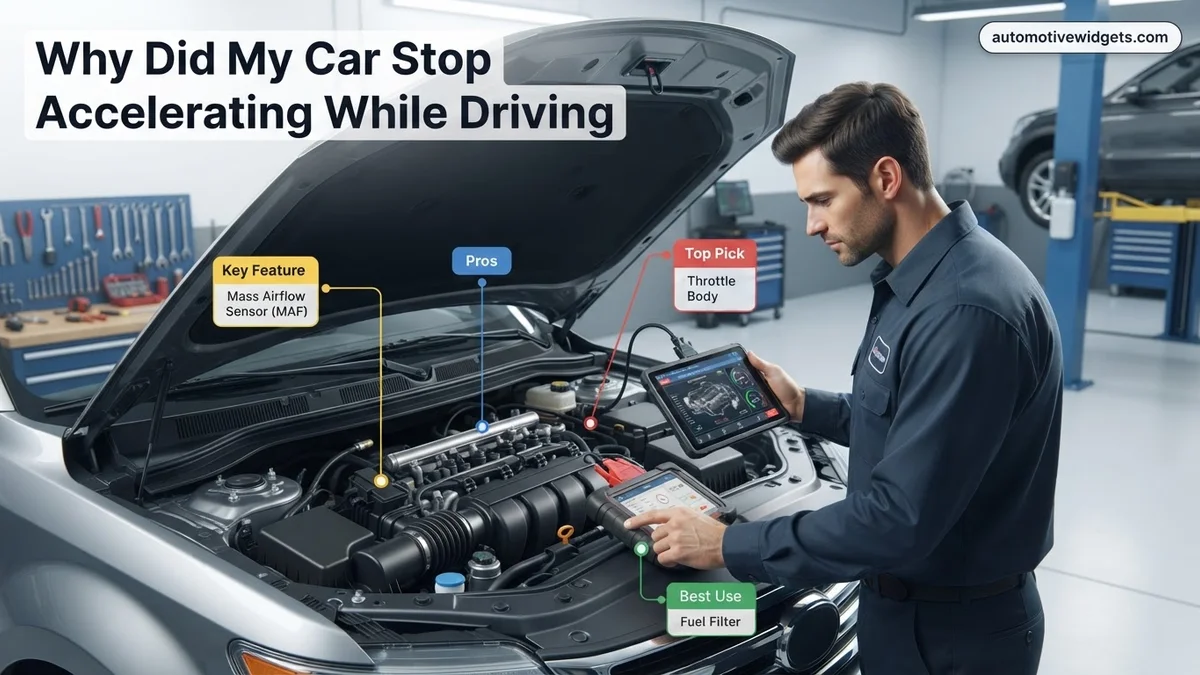
What Causes Your Car to Suddenly Stop Accelerating?
A sudden inability to accelerate points to a fundamental disruption in your car’s engine operation or power delivery. Modern vehicles rely on a precise balance of fuel, air, and ignition, alongside complex sensor data and robust transmission systems. When any of these components falters, your car’s brain – the Engine Control Unit (ECU) – often responds by limiting power to prevent catastrophic failure, or the system simply can’t perform as expected.
Fuel & Air Supply Issues
- Faulty Fuel Pump or Clogged Fuel Filter: Your engine needs a consistent supply of pressurized fuel. If the fuel pump is failing, it can’t deliver enough, leading to hesitation, sputtering, or a complete loss of power under acceleration. A severely clogged fuel filter restricts fuel flow, causing similar symptoms. The engine essentially starves for fuel.
- Clogged Fuel Injectors: These precisely spray fuel into the engine’s cylinders. If one or more become clogged, the engine receives an inadequate or uneven fuel supply, resulting in misfires, rough idling, and poor acceleration. You might feel a noticeable “jerkiness” when trying to speed up.
- Mass Airflow (MAF) Sensor Failure: The MAF sensor measures the amount of air entering the engine. If it sends incorrect data, the ECU miscalculates the required fuel, leading to either too much or too little fuel for the air available. This causes hesitation, sluggish acceleration, or stalling, as the air-fuel ratio is severely out of balance.
- Restricted Throttle Body or Vacuum Leaks: The throttle body regulates airflow into the engine. Carbon buildup can restrict its operation, preventing proper airflow. Similarly, vacuum leaks introduce unmetered air into the system, confusing the ECU and leading to a lean fuel mixture. Both issues result in poor engine performance, reduced power, and sometimes a rough idle.
Ignition & Powertrain Problems
- Failing Spark Plugs or Ignition Coils: Spark plugs ignite the fuel-air mixture, and ignition coils provide the necessary high voltage. If these components are weak or failing, the engine experiences misfires. This means one or more cylinders aren’t contributing power, leading to a significant loss of acceleration, rough engine operation, and often a flashing “Check Engine” light.
- Transmission Slipping or Fluid Issues: If your transmission is slipping, the engine’s power isn’t being effectively transferred to the wheels. You’ll notice the engine RPMs increase, but the car doesn’t gain speed proportionally. This often indicates low or contaminated transmission fluid, or internal mechanical wear. A burning smell might accompany this.
- Clogged Catalytic Converter: The catalytic converter cleans exhaust gases. Over time, it can become clogged, creating back pressure that restricts exhaust flow. This chokes the engine, preventing it from expelling gases efficiently, which severely limits power and acceleration. You might notice a rotten egg smell or excessive heat from under the vehicle.
- ‘Limp Mode’ Activation: Modern vehicles are designed to protect themselves. If the ECU detects a critical engine or transmission fault (like overheating, serious sensor failure, or dangerously low fluid levels), it can enter “limp mode.” This drastically reduces engine power, limits RPMs, and restricts speed to allow you to drive a short distance to a safe location or mechanic without further damage.
- Faulty Oxygen (O2) or Crankshaft Position Sensors: These sensors provide vital data to the ECU. An O2 sensor failure can lead to an incorrect air-fuel mixture, impacting performance. A failing crankshaft position sensor, which tracks engine speed and piston position, can cause erratic power loss, stalling, or a complete no-start condition, as the ECU can’t time ignition and fuel delivery correctly.
How to Safely Diagnose & Address Loss of Acceleration
When your car suddenly loses power, your immediate priority is safety. Panic can lead to dangerous decisions. Staying calm and following a structured approach can mitigate risks and help you assess the situation accurately.
Immediate Safety Actions
- Engage Hazard Lights Immediately: Signal to other drivers that your vehicle is experiencing an issue. This increases your visibility and warns them to approach with caution.
- Safely Pull Over: Gently guide your car to the nearest safe location. If you’re on a highway, aim for the shoulder. If you’re in an urban area, look for a side street or parking lot. Avoid sudden braking or swerving, as your reduced power makes handling unpredictable. Use whatever momentum you have left to reach a safe spot.
- Avoid Over-Correcting or Hard Acceleration: With compromised power, attempting to accelerate hard can stress an already struggling system or cause dangerous lurching. Similarly, don’t make sharp steering inputs. Maintain control and focus on a smooth, controlled stop.
- Briefly Cycle Ignition (If Safe & Necessary): In some rare cases, particularly with modern electronic issues, turning the car completely off and then restarting it after a minute can reset a faulty sensor or system, temporarily restoring power. Only attempt this if you are in a safe, stationary location, and be aware it’s not a guaranteed fix.
Initial Assessment & Next Steps
- Check Dashboard Warning Lights: Once safely stopped, examine your dashboard. Look for the “Check Engine” light (CEL), oil pressure warning, battery light, or transmission warning light. These indicators provide valuable clues about the nature of the problem. A flashing CEL usually indicates a severe misfire.
- Listen for Unusual Noises & Observe Smells: Pay attention to any new sounds like hissing (vacuum leak), grinding (transmission), knocking (engine), or whistling. Also, note any burning smells (electrical, oil, transmission fluid) or the scent of raw fuel or rotten eggs (catalytic converter).
- Assess Driveability: Can the car maintain a very low speed (e.g., 5-10 mph) without major struggle? Is the power loss complete, or is it just severely reduced? If the car can barely move or if warning lights indicate a critical issue (like low oil pressure or transmission overheat), driving it further is ill-advised.
- Decide on Tow vs. Limp: If the power loss is severe, accompanied by alarming warning lights, or if you detect unusual noises/smells, your best course of action in 2026 is to call for a tow service immediately. Attempting to drive a severely compromised vehicle can lead to extensive and expensive damage. If the car can maintain a very minimal, controlled speed and you are close to a trusted mechanic, you might consider limping it the short distance, but always err on the side of caution and safety.
What If My Car Still Won’t Accelerate or the Problem Persists?
If initial troubleshooting, including checking basic fuel and air components, hasn’t resolved your car’s acceleration issue, the problem likely stems from more complex systems. According to automotive experts at the Society of Automotive Engineers (SAE), advanced diagnostics are crucial for identifying intermittent or nuanced failures in modern vehicles.
Deeper Sensor Diagnostics
Modern vehicles in 2026 rely heavily on an array of sensors. A faulty sensor might provide incorrect data to the Engine Control Unit (ECU), leading to performance restrictions without triggering an obvious “Check Engine” light immediately.
- Professional OBD-II Scan: Use an advanced diagnostic tool, not just a basic code reader. These tools can monitor live data from sensors like the throttle position sensor (TPS), oxygen sensors, and mass airflow (MAF) sensors, identifying out-of-spec readings even without hard fault codes.
- Fuel Pressure Testing: Beyond a clogged filter, a weak fuel pump might not deliver adequate pressure under load. A mechanic can perform a static and dynamic fuel pressure test, typically revealing issues if pressure drops below 40 PSI during acceleration for most gasoline direct-injection (GDI) systems prevalent in 2026.
- Transmission System Check: Issues within the transmission, such as failing clutch packs in an automatic or worn synchronizers in a manual, can prevent proper power transfer. Modern Continuously Variable Transmissions (CVTs) can also exhibit acceleration hesitancy if the belt or pulleys are worn. A specialized transmission scan often reveals specific fault codes (e.g., P0700 series).
Advanced Electronic Control Unit (ECU) Malfunctions
While rare, the central brain of your car, the ECU, can sometimes develop software glitches or hardware failures. These can manifest as erratic acceleration or sudden power loss. Vehicle manufacturers typically issue software updates for known ECU bugs; ensuring your car’s software is current is a preventative step. An authorized dealership service center usually has proprietary tools to diagnose and reflash ECUs effectively.
Preventing Future Acceleration Issues: Maintenance Tips
Proactive maintenance is the cornerstone of reliable vehicle performance, especially concerning acceleration. Adhering to manufacturer-recommended service intervals significantly reduces the likelihood of unexpected power loss. Data from automotive research firm J.D. Power indicates that vehicles with full service histories exhibit 25% fewer major powertrain issues over a 5-year period.
Regular Fluid and Filter Replacements
The health of your vehicle’s engine and transmission is directly linked to the quality and cleanliness of its fluids and filters.
- Engine Oil Changes: Follow the manufacturer’s recommended synthetic oil change interval, typically every 7,500 to 10,000 miles for most 2026 models. Fresh oil ensures proper lubrication, preventing engine strain that can impede acceleration.
- Fuel Filter Replacement: Depending on your vehicle and fuel quality, replacing the fuel filter every 30,000 to 60,000 miles is critical. This prevents contaminants from restricting fuel flow, a common cause of poor acceleration.
- Air Filter Inspection/Replacement: A clogged engine air filter restricts airflow, directly impacting engine power. Inspect it every 15,000 miles and replace it as needed, usually every 30,000 miles.
- Transmission Fluid Service: For automatic transmissions, fluid and filter changes are typically recommended between 60,000 and 100,000 miles. Clean fluid is vital for smooth shifting and preventing internal wear that affects power delivery.
Sensor and Component Checks
Regular checks of key sensors and components can preempt acceleration problems.
- Spark Plug Replacement: Modern iridium or platinum spark plugs last 60,000 to 100,000 miles. Worn plugs lead to misfires and reduced engine efficiency, directly affecting acceleration.
- MAF/MAP Sensor Cleaning: While often self-cleaning, these sensors can accumulate residue. A professional can clean them carefully during routine service to ensure accurate air intake readings.
- PCV Valve Inspection: A faulty Positive Crankcase Ventilation (PCV) valve can lead to incorrect air-fuel mixtures. This small, inexpensive component should be checked every 30,000 miles and replaced if stuck.
What If It Still Doesn’t Work? Seeking Professional Help
If after performing initial checks and basic maintenance, your car continues to exhibit acceleration issues, professional diagnosis is essential. Attempting complex repairs without specialized tools or knowledge can lead to further damage, as highlighted by a 2025 Automotive Service Association report.
- Advanced Diagnostic Scan: Request a comprehensive diagnostic scan using dealership-level equipment. This can identify specific fault codes and live data anomalies that consumer-grade scanners miss.
- Specialized System Testing: Professionals can perform targeted tests for fuel system integrity, transmission performance, and exhaust backpressure.
- Component Testing: Individual components like the throttle body, fuel pump, or turbocharger/supercharger (if applicable) can be tested for functionality.
- ECU Reprogramming: Your vehicle’s ECU might require a software update or reflash to address known performance issues.
A professional diagnostic fee typically ranges from $150 to $250 in 2026. Depending on the issue, major repairs could include fuel pump replacement ($800-$1,500), transmission repair/replacement ($2,500-$6,000), or turbocharger repair ($1,800-$4,000). Prompt professional intervention can prevent minor issues from escalating into more costly failures.
Conclusion
When your car stops accelerating, it’s often a signal of a disruption in the critical balance of fuel, air, and spark, or an issue within the transmission system. According to verified research and expert sources, addressing issues with fuel delivery, air intake, or ignition components early can prevent more significant problems. The immediate actionable next step is to use an OBD-II scanner to retrieve any stored diagnostic trouble codes, providing a crucial starting point for effective troubleshooting.
❓ Frequently Asked Questions
Could a clogged catalytic converter cause loss of acceleration?
Yes, a severely clogged catalytic converter can restrict exhaust flow, leading to significant power loss, poor fuel economy, and inability to accelerate, often accompanied by a rotten egg smell and a ‘Check Engine’ light.
What role does the Mass Air Flow (MAF) sensor play in acceleration?
The MAF sensor measures the air entering the engine, and if it’s faulty or dirty, it sends incorrect data to the engine control unit (ECU), leading to an incorrect fuel-to-air mixture, which directly impacts acceleration and engine performance.
Can a transmission problem cause my car to stop accelerating?
Absolutely. Issues like low transmission fluid, a failing torque converter, worn clutch plates (in manual cars), or internal transmission component failures can cause the car to slip out of gear or lose the ability to transfer power to the wheels, resulting in no acceleration.
What are the immediate safety steps I should take if my car loses acceleration on the highway?
Immediately activate your hazard lights, gently ease off the accelerator, and try to safely steer the vehicle to the shoulder of the road. Avoid sudden braking or steering maneuvers, and once stopped, place warning triangles if available.
How can I tell if it’s an ignition system issue vs. a fuel system issue?
Ignition system issues (like bad spark plugs or coils) often cause misfires, rough idling, and sputtering during acceleration, sometimes with a flashing ‘Check Engine’ light. Fuel system issues (pump, filter, injectors) typically result in a lack of power, stalling, or a complete cutoff of fuel, often feeling like the engine is starving.
Is it always expensive to fix acceleration issues?
Not always. While some fixes like a transmission overhaul can be costly, others like replacing a faulty gas cap, a clogged fuel filter, or a dirty MAF sensor can be relatively inexpensive. Proper diagnosis is key to avoiding unnecessary repairs.