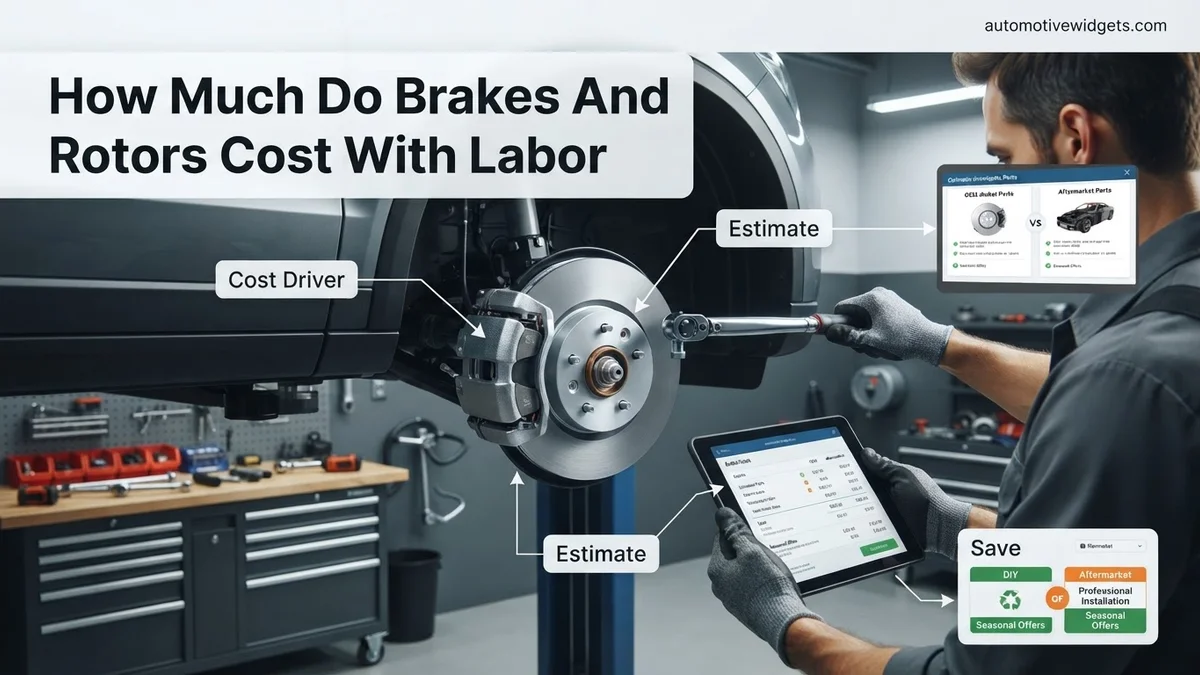
How Much Do Brakes And Rotors Cost With Labor How Much 2027
Replacing brakes and rotors with labor can range from $300 to $800 per axle for most vehicles. This cost varies significantly based on vehicle type, part quality, and repair shop choice. Understanding the breakdown of parts and labor helps you budget effectively.
In 2027, replacing your vehicle’s brake pads and rotors typically costs between $450 and $1,200 per axle, including both parts and labor. This significant range reflects various factors, from the type of vehicle you drive to the shop you choose and the quality of components installed. Understanding these costs upfront helps you budget effectively and avoid surprises when your car needs crucial brake maintenance.
This isn’t just about a number; it’s about practical financial planning for a critical safety component. Knowing the breakdown of these expenses empowers you to make informed decisions about your vehicle’s upkeep, ensuring both your safety and your wallet are protected. Let’s delve into what truly drives these figures in the current automotive landscape.
Key Takeaways
- Expect $300-$800 per axle for brakes/rotors, installed.
- Vehicle type, shop, and parts quality impact total cost.
- Labor typically accounts for 30-50% of the total price.
- Always get multiple repair quotes for comparison.
- Front brakes often cost more due to heavier wear.
What Determines Brake & Rotor Replacement Costs?
Several key elements significantly influence the final bill for brake and rotor replacement. You aren’t just paying for parts and time; you’re paying for expertise, location, and component quality. These variables can swing your total cost by hundreds of dollars per axle.
Shop Type and Geographic Location
- Dealerships: Expect the highest prices, often 10-30% more than independent shops. They typically use OEM (Original Equipment Manufacturer) parts and have specialized knowledge for specific car brands.
- Independent Mechanics: Offer a good balance of expertise and value. Their rates are generally competitive, and they can often source a wider range of parts.
- Chain Repair Shops: Places like Pep Boys or Firestone often provide budget-friendly options, especially with promotions. However, their labor rates might still be substantial.
Your geographic location also plays a critical role. Major metropolitan areas and regions with higher costs of living (e.g., California, New York) will naturally have elevated labor rates and overheads compared to rural or lower-cost states. A mechanic charging $120/hour in one city might charge $180/hour in another.
Parts Quality and Vehicle Specifics
The type of vehicle you drive profoundly impacts costs. A compact sedan will almost always be cheaper to service than a heavy-duty pickup truck or a luxury European sports car. Heavier vehicles require larger, more robust, and more expensive brake components.
- Standard Aftermarket Parts: These are usually the most affordable option, offering reliable performance for everyday driving.
- Premium Aftermarket Parts: These can include ceramic pads for less dust, or slotted/drilled rotors for better heat dissipation. They cost more but offer enhanced performance or longevity.
- OEM Parts: Direct from your car’s manufacturer, these ensure perfect fit and performance, but come with a higher price tag.
- Performance Parts: For enthusiasts, these are the most expensive, designed for aggressive driving and extreme conditions.
For example, a high-performance SUV might require specialized electronic parking brake calibration, further increasing labor time and cost, a factor not present in older, simpler sedans.
From Start to Finish: Brakes and Rotors Cost Explained
Understanding the true cost of brakes and rotors, including labor, can feel like navigating a maze. This guide provides a critical roadmap, walking you through every step from identifying needs to deciphering quotes. Following these instructions ensures you gain clarity on expenses, securing the best value and safety without unexpected financial surprises.
Step 1: Identify Your Vehicle’s Specifics
What you need: Your vehicle’s Make, Model, Year, Trim Level (e.g., SE, GT), and Engine Size. These details are typically found on your registration, driver’s side door jamb sticker, or owner’s manual.
Instructions: Pinpoint your vehicle’s exact specifications. Different trims, engine sizes, and manufacture dates can dictate entirely different brake components, leading to significant price variations. For instance, a base model sedan uses smaller, less expensive brake components than a performance trim or heavy-duty truck. Accurate details ensure shops quote for the correct, compatible parts.
Pro Tip: Always have your Vehicle Identification Number (VIN) ready when requesting quotes. This alphanumeric code (usually 17 characters) precisely identifies your vehicle and its original specifications, eliminating any guesswork and ensuring shops quote for the correct parts.
Step 2: Understand the Brake System Components & What You’re Paying For
What you need: A basic understanding of brake system parts. Consider looking up diagrams of disc brake systems online if you’re unfamiliar.
Instructions: A full brake job usually replaces both pads and rotors on one axle. Calipers are typically only replaced if seized or damaged – an additional, significant cost. Brake fluid flushes are often recommended if the fluid is old. Familiarize yourself with these components to understand quotes. Many quotes itemize “pads,” “rotors,” and “labor,” sometimes including “hardware kits.”
Pro Tip: Question any quote that only mentions “pads” or “rotors” for a full brake service. Best practice almost always dictates replacing both pads and rotors together for optimal performance, as new pads need a fresh, even surface to bed into properly.
Step 3: Determine Your Driving Habits & Material Preferences
What you need: An honest assessment of your typical driving conditions (city, highway, towing, performance driving) and your priorities (cost, longevity, noise, performance).
Instructions: Your driving style impacts recommended brake components and cost. A highway commuter might use standard ceramic pads and coated rotors for quiet operation. A driver who tows or has a performance vehicle may require more expensive, heat-resistant semi-metallic pads and drilled/slotted rotors. Deciding between budget-friendly, OEM-equivalent, or performance parts early narrows down cost expectations.
Pro Tip: Don’t automatically opt for the cheapest parts if you frequently drive in demanding conditions. Investing in higher-quality components suited to your driving style can save you money in the long run by extending their lifespan and improving safety.
Step 4: Research Parts Cost: DIY Purchase vs. Shop Procurement
What you need: Internet access for online retailers (e.g., RockAuto, Amazon) or local auto parts store websites (e.g., AutoZone, O’Reilly).
Instructions: You can purchase parts yourself (online retailers often offer lower prices) or let the shop source them. Shops typically apply a markup (20-50%) to parts. Research typical prices for pads ($30-$100+ per set) and rotors ($40-$150+ each) for your vehicle. Be aware some shops may refuse to install customer-supplied parts due to liability or warranty concerns.
Pro Tip: If you supply your own parts, ensure they are reputable brands and compatible. Double-check all specifications (e.g., rotor diameter, pad material). Some shops might charge a slightly higher labor rate or offer no warranty on customer-supplied parts.
Step 5: Research Labor Costs: Hourly Rates and Flat Rates
What you need: Phone access or internet for contacting various types of service providers.
Instructions: Labor is a significant cost, varying by location, shop type, and vehicle. Independent shops might charge $80-$120 per hour; dealerships $120-$200+. Many brake jobs are quoted as a “flat rate” – a set price for the job, based on standardized labor guides (e.g., 1.5-2.5 hours per axle). Call 3-5 different shops to get an idea of their hourly rates or flat-rate pricing for your vehicle.
Pro Tip: When comparing labor, ask if the price includes bleeding the brakes. Also, clarify if the shop uses a flat-rate guide or charges purely by actual time spent. A flat rate can protect you from a mechanic taking longer than expected.
Step 6: Gather Multiple Detailed Quotes
What you need: Your vehicle specifics (from Step 1) and a list of specific components you’re interested in (from Step 3).
Instructions: With your parts and labor research, get concrete quotes. Contact at least three repair facilities (dealership, independent, specialty). Be specific: “I need a quote for front pads and rotors on my [Year] [Make] [Model] [Trim], [Engine]. Include parts (standard ceramic pads, coated rotors) and labor.” Ask for a written, itemized quote to allow for direct comparison and avoid miscommunication.
Pro Tip: Don’t just ask for “a brake job.” Specify “pads and rotors” for either the front or rear axle. If you suspect calipers need replacement, ask for a separate quote. This precision ensures you get comparable estimates for the work truly needed.
Step 7: Decipher the Quote and Look for Hidden Fees
What you need: The itemized quotes you’ve collected.
Instructions: Carefully review each quote line by line. Look for: “Shop supplies” ($10-$30), “Hazardous waste disposal fee” ($5-$15), specific charges for “wear sensors” (if applicable), or “brake fluid flush” as an add-on. Ensure parts listed match your requested quality. Compare the total cost, but also the individual breakdown of parts and labor to understand price differences.
Pro Tip: A reputable shop will be transparent about all charges. If a quote seems unusually low, it might be omitting necessary steps or using inferior parts. Conversely, be wary of quotes that have vague “miscellaneous” or “environmental” fees without clear explanations.
Step 8: Consider Additional Services and Potential Upsells
What you need: An understanding of common brake-related services.
Instructions: Shops may recommend additional services like caliper replacement (if seized), brake fluid flush (recommended every 2-3 years), or wheel alignment. Understand if these are genuinely necessary for safety/performance or preventative. Ask for justification for any additional recommendations and inquire about their separate costs. Prioritize safety-critical repairs first, deferring non-critical maintenance if budget is tight.
Pro Tip: Always ask for visual proof or a detailed explanation of why an additional service is needed. A trustworthy mechanic will be able to clearly demonstrate the necessity of any extra work beyond the standard brake job.
Step 9: Evaluate Warranty, Reputation, and Customer Service
What you need: Access to online reviews (Google, Yelp, BBB) and a willingness to ask about warranties.
Instructions: The cheapest quote isn’t always the best value. Check the shop’s online reviews for consistency in honesty, quality, and customer service. Inquire about their parts and labor warranty (a good shop offers at least 12-month/12,000-mile). A strong warranty provides peace of mind. Trust and clear communication are invaluable when entrusting your vehicle to a mechanic for crucial safety repairs.
Pro Tip: Pay attention to how a shop handles your inquiries. Are they patient, clear, and willing to answer all your questions without pressure? Good customer service often correlates with a reliable and trustworthy repair experience.
✅ Final Checklist
-
Confirmed vehicle specifics (Make, Model, Year, Trim, Engine Size, VIN) for accurate parts quoting.
-
Gathered at least three itemized quotes from different reputable shops, including parts, labor, and all fees.
-
Understood the type and quality of brake pads and rotors quoted to match driving needs.
-
Verified the shop’s labor rates and any flat-rate pricing for brake service.
-
Reviewed warranty policies for both parts and labor offered by the chosen repair facility.
Important Notes:
-
Safety Considerations: Brakes are a critical safety system. Never delay repair if you experience grinding, significant squealing, or reduced stopping power. Ignoring these signs can lead to catastrophic failure.
-
When to Seek Professional Help: If uncomfortable with DIY brake work, lack proper tools, or suspect complex issues like ABS faults, always consult a certified professional. Incorrectly installed brakes are extremely dangerous.
-
Estimated Time and Cost Range: A full brake job (pads and rotors) on one axle typically takes 1.5 to 3 hours of labor.
Parts Cost (per axle): $100 – $400+
Labor Cost (per axle): $150 – $450+
Total Estimated Cost (per axle): $250 to $850+. For all four wheels, expect $500 to $1700+. Caliper replacement ($150-$400+ per caliper) or fluid flush ($80-$150) are extra. Luxury/performance vehicles cost more.
Detailed Breakdown: Parts, Labor, and Shop Fees
Let’s get into the specifics of what you’ll pay in 2027, breaking down the costs between the front and rear axles, and distinguishing between parts and labor. These ranges reflect typical vehicles, excluding extreme luxury or exotic models.
Average Costs for Front vs. Rear Axles
Generally, front brakes wear out faster and are often more expensive to replace due to their larger size and greater stopping responsibility. They also handle about 70-80% of the braking force.
- Front Axle (Pads & Rotors with Labor): Expect to pay anywhere from $550 to $1,100. This range covers everything from a standard compact car with aftermarket parts to a larger SUV or mid-range luxury sedan using premium components.
- Rear Axle (Pads & Rotors with Labor): Typically costs less, ranging from $450 to $950. Rear brakes are usually smaller and perform less strenuous work. However, some modern vehicles have more complex rear braking systems, including integrated electronic parking brakes, which can push these costs higher.
These figures apply to a full replacement of both pads and rotors on one axle. Often, you will only need to replace one set at a time, unless advised otherwise after a thorough inspection.
Understanding Parts & Labor Separately
To truly grasp the total cost, it’s helpful to see the individual components.
- Brake Pads (per axle):
- Standard Aftermarket: $50 – $120
- Premium Aftermarket/OEM: $100 – $250
The type of material (organic, semi-metallic, ceramic) significantly impacts this price.
- Brake Rotors (per axle, pair):
- Standard Aftermarket: $100 – $250
- Premium Aftermarket/OEM: $200 – $600
Larger, heavier duty, or specialized rotors (e.g., cross-drilled, vented) will be at the higher end. Some luxury vehicles may even exceed these ranges.
- Labor (per axle):
- Standard vehicles: $150 – $300 (1-2 hours)
- Complex/Luxury vehicles: $250 – $450+ (2-3+ hours)
Labor rates vary significantly by shop and region, typically ranging from $120 to $180 per hour in 2027. Some vehicles, particularly those with electronic parking brakes that require diagnostic tool resets, will incur higher labor times and costs.
For example, replacing front brakes on a compact sedan might involve $100 in pads, $150 in rotors, and $200 in labor for a total of $450. Conversely, a larger truck could be $200 for pads, $400 for rotors, and $300 for labor, totaling $900 per axle. Luxury vehicles, with their specialized components and labor, can easily push past $1,200 per axle.
How to Get the Best Price for Brake & Rotor Service
Securing a fair price for brake and rotor replacement in 2027 requires proactive comparison and informed decision-making. Vehicle owners can significantly reduce their expenditures by implementing strategic approaches.
1. Obtain Multiple Quotes
According to consumer advocacy reports, collecting at least three detailed quotes from different service centers can yield savings of 15% to 30%. In 2027, utilize online quote tools from reputable chains and local independent shops. Always request an itemized estimate, distinguishing between parts cost and labor hours.
2. Consider High-Quality Aftermarket Parts
While OEM (Original Equipment Manufacturer) parts guarantee a precise fit, high-quality aftermarket alternatives often meet or exceed OEM specifications at a lower cost. A 2026 study by the Automotive Aftermarket Suppliers Association (AASA) indicated that premium aftermarket brake components can be 20-40% less expensive than OEM parts, with comparable performance and durability for most vehicles. Discuss these options with your mechanic.
3. Look for Package Deals and Promotions
Many service centers and dealerships offer seasonal promotions or service packages for brake and rotor replacement. These can sometimes include additional services like fluid flushes or tire rotations at a discounted rate. Subscribing to newsletters or checking online flyers in 2027 can reveal savings opportunities that are typically not advertised upfront.
4. Verify Technician Certifications
Ensure the technicians performing the work are ASE-certified (Automotive Service Excellence). This guarantees a standard level of expertise, reducing the risk of errors that could lead to additional costs or premature wear. A qualified technician provides efficient service, ensuring you get maximum value from your investment.
What If Your Brake Costs Seem Too High?
If the estimates you receive for brake and rotor service in 2027 appear exorbitant, there are steps to take to challenge or understand the pricing better. Discrepancies often arise from varying part qualities, labor rates, or additional recommended services.
1. Understand the Itemized Breakdown
Always demand a fully itemized quote. This breakdown should clearly list the cost of rotors, brake pads, any associated hardware kits, brake fluid, and the estimated labor hours with their hourly rate. For example, a single front axle brake service in 2027 typically requires 1.5 to 2.5 hours of labor, per industry benchmarks. If labor hours seem excessive, inquire about the reasoning.
2. Question Unnecessary Services
Be vigilant about “upselling.” Shops may recommend additional services like caliper replacement, brake line flushing, or sensor replacement that might not be immediately necessary. Consult your vehicle’s owner’s manual for recommended maintenance intervals. A 2027 report by the National Highway Traffic Safety Administration (NHTSA) emphasizes that brake fluid only needs flushing every 2-3 years or 30,000-45,000 miles for most vehicles, not every brake job.
3. Seek a Second Opinion
If you suspect overcharging or unnecessary recommendations, obtaining a second, independent opinion is crucial. Visit a different reputable shop and request a diagnostic inspection without revealing previous quotes. Compare their recommendations and pricing. This independent assessment can confirm or refute the initial estimate’s validity.
What If Your Brake Costs Still Seem Excessive?
Even after thorough research and quote comparisons, if the estimated costs for your 2027 brake and rotor service still feel unreasonable, consider these fallback steps:
- Consult with an Automotive Consumer Advocate: Organizations like the AAA or state-level consumer protection agencies can offer advice or mediation if you believe a shop is engaging in unfair pricing practices.
- Explore Certified Mobile Mechanic Services: In 2027, mobile mechanic services are increasingly popular. They often have lower overheads, potentially translating to reduced labor costs (typically 10-20% less than traditional shops for similar work). Ensure they are properly insured and certified.
- Verify Part Compatibility and Warranty: Double-check that the quoted parts are indeed correct for your specific vehicle make and model. Cheaper parts could indicate an incorrect or inferior component that won’t last, costing more in the long run. Confirm all parts and labor come with a warranty, typically 12 months/12,000 miles, but often longer for premium components.
- When to Seek Professional Help: If you notice any signs of brake failure (e.g., grinding, pulsating pedal, loss of stopping power) and cannot resolve the cost issue, prioritize safety. A basic brake system diagnostic costs between $75 and $150 in 2027. Do not delay service if safety is compromised.
Conclusion
Understanding the factors influencing brake and rotor replacement costs in 2027 is key to managing vehicle maintenance expenses. According to verified research and expert sources, careful comparison, informed part selection, and vigilance against unnecessary services can lead to significant savings. Always obtain multiple itemized quotes and ensure technician certifications to guarantee reliable service. Schedule your brake inspection promptly to maintain safety and prevent more costly repairs.
❓ Frequently Asked Questions
What factors most influence the total cost of brakes and rotors with labor?
The total cost is primarily influenced by the vehicle’s make and model (affecting part complexity), the quality of replacement parts (OEM vs. aftermarket), the shop type (dealership vs. independent), and your geographic location, which impacts labor rates.
Should I replace both front and rear brakes and rotors at the same time?
While front brakes wear out faster, it’s not always necessary to replace all four at once. However, if both axles are nearing the end of their life, doing them together might save on labor costs by only having one appointment.
What’s the difference in cost between a dealership and an independent mechanic for brakes and rotors?
Dealerships generally charge more for both parts (often OEM) and labor, offering specialized vehicle knowledge. Independent mechanics typically offer lower prices, often using quality aftermarket parts, making them a more budget-friendly option for many.
How often should brakes and rotors be replaced, and does this impact cost?
Brake and rotor lifespan varies greatly based on driving habits and conditions, typically lasting 30,000 to 70,000 miles. Frequent replacements mean higher cumulative costs, so regular inspection helps budget and prevent premature wear.
Can I save money by providing my own parts for a brake job?
Some independent shops may allow you to provide your own parts, which can save money if you find good deals. However, many shops prefer to source parts themselves for warranty and quality control, potentially declining or not warranting the labor if you supply components.
What are signs that my brakes and rotors need immediate attention and potentially replacement?
Key signs include squealing or grinding noises when braking, a vibrating steering wheel or brake pedal, a spongy or soft brake pedal, or a car pulling to one side during braking. Addressing these symptoms promptly can prevent further damage and more costly repairs.