How Much Should It Cost To Change Spark Plugs How Much 2027
The cost to change spark plugs typically ranges from $100 to $400 for parts and labor, but can vary significantly based on vehicle make, engine complexity, and spark plug type. Understanding these factors is key to budgeting for this essential maintenance task.
If you’re wondering how much it will cost to have your spark plugs replaced in 2027, you’re typically looking at a total bill ranging from $150 to $750, all-inclusive. While that’s a broad estimate, most standard vehicles will fall into the $300-$500 range for parts and labor. This significant price spread isn’t random; it’s heavily influenced by your specific vehicle, the type of spark plugs required, and where you get the work done.
Understanding these cost factors helps you budget accurately and ensures you’re not overpaying for a routine maintenance item. Getting a professional spark plug change keeps your engine running efficiently, optimizes fuel economy, and prevents more expensive repairs down the line. By knowing the breakdown of parts and labor, you can confidently discuss pricing with your mechanic and make informed decisions about your vehicle’s upkeep.
Key Takeaways
- Spark plug replacement averages $100-$400 total.
- V6/V8 engines cost more due to labor access.
- Iridium plugs are pricier but last much longer.
- DIY saves labor costs but requires skill.
- Get multiple quotes for the best service price.
What Causes Spark Plug Replacement Costs to Vary So Much?
The total cost for replacing spark plugs isn’t a one-size-fits-all number. Several critical factors contribute to the wide range you might encounter, primarily impacting the labor time and the price of the spark plugs themselves. Being aware of these variables helps you understand why your quote might differ from a friend’s, even if you both drive modern vehicles.
Vehicle Specifics and Engine Configuration
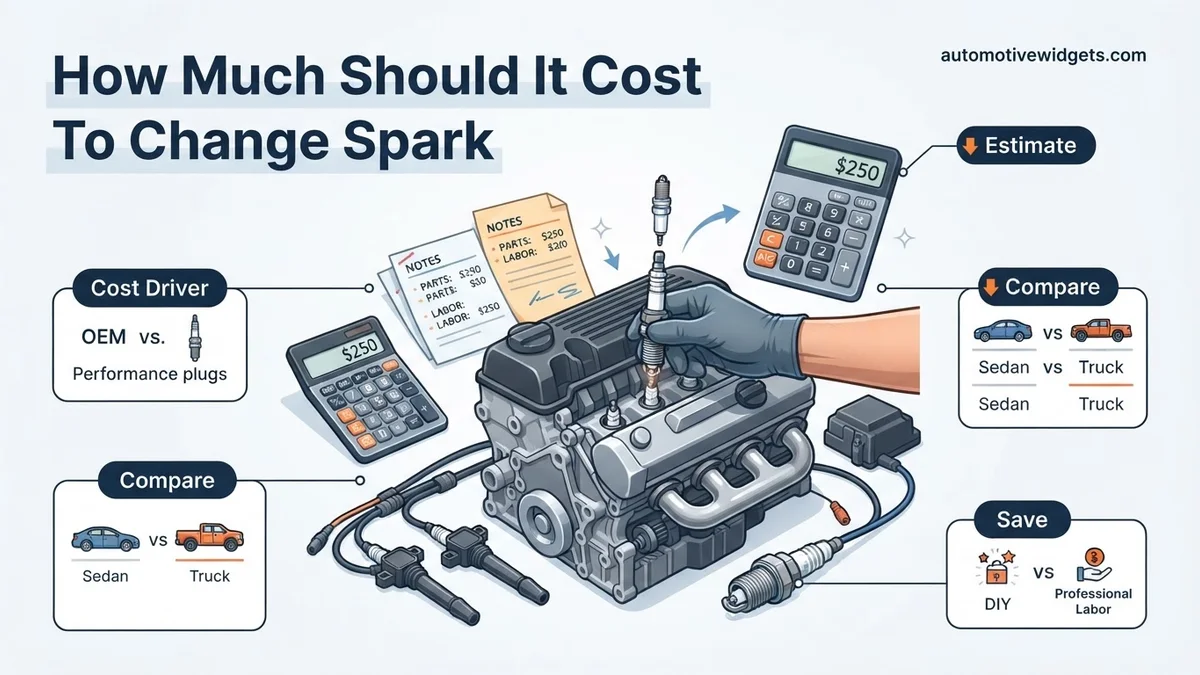
- Engine Type: An inline 4-cylinder engine generally has easier-to-access spark plugs compared to a V6 or V8. On some V-engines, reaching the plugs on one side might require removing the intake manifold, significantly increasing labor time.
- Make and Model: European luxury cars or certain specialized engines (e.g., horizontally opposed “boxer” engines in Subarus) often have tighter spaces or require specialized tools, which can push labor costs higher. A Honda Civic’s spark plug change is typically much simpler than a Porsche Cayenne’s.
- Plug Quantity: A 4-cylinder engine needs 4 plugs, a V6 needs 6, and a V8 needs 8 (or even 16 in some modern dual-plug-per-cylinder designs). More plugs directly mean higher parts cost and usually more labor time.
Spark Plug Type and Quality
The material of the spark plug electrode significantly affects its price and lifespan. By 2027, you’ll still primarily encounter three main types:
- Copper Plugs: These are the least expensive, offering good conductivity but wearing out faster. They are less common in newer vehicles.
- Platinum Plugs: More durable and expensive than copper, these offer better longevity and performance. They are a common OEM choice for many vehicles.
- Iridium Plugs: The most durable and expensive option, iridium plugs offer superior performance and extended service intervals, often lasting 100,000 miles or more. They are standard in most modern, high-performance, and luxury vehicles.
From Start to Finish: Spark Plug Replacement Costs Explained
Understanding the cost of replacing spark plugs can feel like navigating a maze, with prices varying wildly based on your vehicle, where you get the service done, and even the type of spark plugs themselves. This comprehensive guide aims to demystify these costs, providing a clear, step-by-step approach to help you estimate expenses, whether you’re tackling the job yourself or opting for professional service. By following these steps, you’ll gain the knowledge to make informed decisions and budget effectively for this essential vehicle maintenance task, ensuring your engine runs smoothly without breaking the bank.
Step 1: Understand the Role of Spark Plugs and Replacement Intervals
What you need: Your vehicle’s owner’s manual or a reliable online resource for your specific make and model’s maintenance schedule.
Instructions: Before diving into costs, it’s crucial to understand what spark plugs do and why they need replacing. Spark plugs ignite the air-fuel mixture in your engine’s cylinders, creating the power that drives your vehicle. Over time, their electrodes wear down, leading to misfires, reduced fuel efficiency, and poor engine performance. Consult your owner’s manual for the manufacturer’s recommended replacement interval, which typically ranges from 30,000 miles for copper plugs to 100,000 miles or more for platinum or iridium plugs. This interval directly influences how often you’ll incur this cost.
Pro Tip: Ignoring recommended replacement intervals can lead to more expensive repairs down the line, such as catalytic converter damage from unburnt fuel. Adhering to the schedule is a cost-saving measure in itself.
Step 2: Identify Your Vehicle’s Specific Spark Plug Requirements
What you need: Your vehicle’s make, model, year, and engine size (e.g., 2015 Honda Civic, 1.8L 4-cylinder). Access to online auto parts websites (like RockAuto, AutoZone, O’Reilly) or a local auto parts store.
Instructions: The type and number of spark plugs your vehicle uses are primary cost drivers. An inline 4-cylinder engine will likely need four plugs, while a V6 or V8 will require six or eight, respectively. Additionally, some high-performance or modern engines may require specialized iridium or platinum plugs, which cost more per unit than traditional copper plugs. Use your vehicle’s information to look up the exact spark plug part numbers compatible with your engine. Note any specific requirements, such as pre-gapped plugs or specific torque specifications for installation.
Pro Tip: Always verify compatibility with your exact vehicle specifications. Using the wrong spark plugs can lead to engine damage or poor performance, making a cheap initial purchase much more expensive in the long run.
Step 3: Research Spark Plug Part Costs
What you need: Identified spark plug type, quantity, and part numbers from Step 2. Internet access for price comparison or visits to local auto parts stores.
Instructions: Now that you know precisely what plugs you need, it’s time to price them out. Individual spark plug prices can vary significantly: basic copper plugs might be as low as $2-$5 each, while high-performance iridium or platinum plugs can range from $10-$25+ per plug. Multiply the unit cost by the number of plugs required for your engine to get a total parts cost. Don’t forget to factor in potential sales tax. Compare prices from various retailers to find the best deal, but prioritize reputable brands known for quality and longevity (e.g., NGK, Denso, Bosch, Champion).
Pro Tip: While saving a few dollars per plug might be tempting, investing in high-quality, OEM-recommended plugs often pays off in terms of engine performance, fuel efficiency, and extended replacement intervals. Also, consider buying a small tube of anti-seize compound and dielectric grease, which are inexpensive but crucial for proper installation.
Step 4: Assess Labor Complexity for DIY vs. Professional Service
What you need: A visual inspection of your engine bay, a basic understanding of mechanical work, and perhaps a quick search for “spark plug replacement [your car model]” videos on YouTube.
Instructions: The accessibility of your spark plugs dramatically influences labor costs. On some vehicles (e.g., many 4-cylinder engines), spark plugs are easily accessible on top of the engine, making it a relatively simple DIY job or a quick professional service. However, on other engines (especially V6 or V8 configurations), some spark plugs might be located deep under an intake manifold, requiring significant disassembly and increasing labor time. Observe your engine bay: can you easily see all the ignition coils/spark plug boots? This assessment helps you understand if the job is simple (1-2 hours) or complex (3-5+ hours), impacting professional labor charges.
Pro Tip: If even one spark plug looks difficult to reach or requires specialized tools you don’t own, a DIY attempt might lead to frustration or costly mistakes. For complex jobs, the time and effort saved by professional service often outweigh the DIY cost savings.
Step 5: Obtain Professional Labor Estimates
What you need: Your vehicle’s make, model, year, and engine size. Contact information for local independent mechanics and authorized dealerships.
Instructions: If you’re not doing the job yourself, getting multiple quotes is essential. Call at least three different repair shops – a dealership, a reputable independent mechanic, and perhaps a chain service center. Provide them with your vehicle details and specifically ask for an estimate for spark plug replacement, clarifying if it includes parts or if you’re providing them. Labor rates typically range from $75 to $150+ per hour, and shops often have a set “flat rate” for common jobs like spark plug changes, which can be anywhere from 1 to 4+ hours of billed time depending on complexity.
Pro Tip: When getting quotes, ask for an “out-the-door” price that includes parts, labor, shop fees, and taxes. Be wary of quotes that are significantly lower or higher than the others; an extremely low price might indicate cutting corners, while a very high price might be overpriced.
Step 6: Factor in Additional Materials and Potential Ancillary Costs
What you need: Awareness of related maintenance items, and budget flexibility.
Instructions: While the spark plugs themselves are the main cost, there might be other items to consider. For DIY, you might need a spark plug socket set, torque wrench, gap gauge (if plugs aren’t pre-gapped), dielectric grease, and anti-seize compound – these tools can add $50-$150 to your initial DIY cost if you don’t already own them. Professionally, shops might recommend replacing ignition coils or spark plug wires if they show signs of wear, especially on older vehicles, which can add $50-$150+ per coil/wire. Sometimes, valve cover gaskets might need replacement if they are leaking and need to be removed for access. Always ask for a breakdown of any additional recommended services.
Pro Tip: Inspecting ignition coils and spark plug wires when plugs are changed is good practice. If they are old or show signs of cracking/corrosion, replacing them simultaneously can save on future labor costs, as much of the engine is already disassembled.
Step 7: Calculate Total Estimated Cost (DIY vs. Professional)
What you need: All gathered cost data: spark plug prices, potential tool costs (for DIY), professional labor estimates, and ancillary material/service costs.
Instructions: Now, sum up all your figures.
For DIY: Total Spark Plug Parts Cost + Tool Purchase Cost (if any) + Anti-Seize/Dielectric Grease.
For Professional Service: Total Spark Plug Parts Cost (if separate) + Estimated Labor Cost (including shop fees) + Cost of any recommended ancillary services/parts.
A typical DIY spark plug change can cost anywhere from $20 (for a 4-cylinder with copper plugs, no new tools needed) to $150 (for a V6 with iridium plugs and basic tools). Professional service can range from $150 for a simple 4-cylinder job to $600+ for a complex V8 or turbo engine requiring extensive labor and specialized plugs. Keep these ranges in mind as you finalize your budget.
Pro Tip: Always add a small contingency fund (10-15%) to your total estimate for unexpected issues, like a seized spark plug or a broken ignition coil connector, especially for older vehicles.
✅ Final Checklist
- Verified recommended spark plug replacement interval for your vehicle?
- Identified the correct type and quantity of spark plugs needed?
- Obtained multiple professional labor quotes (if applicable) and understood what’s included?
- Accounted for all parts, including anti-seize and dielectric grease?
- Considered potential costs for new tools or ancillary repairs (e.g., ignition coils, wires)?
Important Notes:
- Safety considerations or warnings: If attempting DIY, always ensure the engine is cool, disconnect the negative battery terminal before starting, and use appropriate personal protective equipment (gloves, eye protection). Improper installation can damage your engine.
- When to seek professional help: If you lack the necessary tools, mechanical experience, or confidence, or if the job requires extensive engine disassembly (e.g., removing an intake manifold). If a spark plug is seized or breaks during removal, professional help is crucial to avoid further, more expensive damage.
- Estimated time and cost range:
- DIY Time: 1-4 hours, depending on vehicle complexity and experience.
- DIY Cost: $20 – $150+ (for parts and basic supplies/tools).
- Professional Time: 1-5 hours of billed labor.
- Professional Cost: $150 – $600+ (includes parts and labor, highly dependent on vehicle and shop rates).
Detailed Breakdown: Parts, Labor, and Other Cost Drivers
To fully grasp the cost, it’s essential to break down what you’re paying for. The bulk of your bill will consist of the actual spark plugs and the labor hours required for installation. However, other smaller factors can also subtly influence the final price.
Spark Plug Costs (Parts)
In 2027, spark plug prices reflect materials, technology, and market demand. Here’s what you can expect per plug:
- Copper Spark Plugs: Expect to pay $5 – $10 per plug. A set for a 4-cylinder engine would be $20 – $40.
- Platinum Spark Plugs: These will typically cost $10 – $18 per plug. A set for a V6 might run $60 – $108.
- Iridium Spark Plugs: The premium option, these generally range from $18 – $35 per plug. An 8-cylinder vehicle could see parts costs of $144 – $280 just for the plugs.
- Note: Always use the OEM-specified plug type for your vehicle to ensure proper engine function and longevity.
Labor Rates and Estimated Time
Labor is often the largest portion of your spark plug replacement bill, and it varies significantly by shop and region:
- Hourly Shop Rates (2027): Professional automotive shops typically charge between $100 – $180 per hour. In major metropolitan areas or at dealership service centers, these rates can easily climb to $200 per hour or more.
- Estimated Labor Time:
- 4-Cylinder Engines: Generally 0.5 to 1.5 hours. This translates to $50 – $270 in labor.
- V6 Engines: Typically 1.5 to 3 hours, costing $150 – $540 in labor.
- V8 Engines: Can range from 2 to 5 hours, especially if intake manifold removal is required. This means labor could be $200 – $900.
- Complex/Specialty Engines: Some vehicles may require even more time, pushing labor costs higher.
- Additional Services: Sometimes, mechanics might recommend replacing ignition coils, spark plug wires, or performing a throttle body cleaning concurrently. While not strictly part of a “spark plug change,” these can add to the total cost if deemed necessary.
How to Get the Best Price for Spark Plug Replacement (Expert Guide)
Securing an optimal price for spark plug replacement requires strategic planning and informed decision-making. According to a 2026 automotive service trend analysis by J.D. Power, consumers who obtain at least three quotes save an average of 15% on routine maintenance.
1. Obtain Multiple Estimates
Do not settle for the first quote. Reputable service centers understand the competitive landscape.
- Contact Independent Shops: These often have lower overheads than dealerships, translating to potential savings of 10-25% on labor rates in 2027.
- Check Dealership Service Specials: Dealerships frequently offer promotions, especially for common services like spark plug replacement, to attract customers.
- Use Online Quotation Tools: Several platforms in 2027 provide instant estimates from certified mechanics in your area. Cross-reference these with direct calls.
2. Consider Performing DIY (If Qualified)
For individuals with mechanical aptitude and the right tools, replacing spark plugs can be a DIY task. This eliminates labor costs entirely. However, specialized tools for specific engine types (e.g., torque wrenches, gap gauges, coil pack pullers) are essential. Improper installation can lead to costly engine damage. A 2027 study by CarMD shows misaligned spark plugs causing up to $1,500 in secondary engine repairs.
3. Bundle Services
Inquire about discounts for combining spark plug replacement with other scheduled maintenance, such as oil changes or air filter replacements. Many shops offer a reduced overall price for package deals, typically saving 5-10% on the combined services.
What If Spark Plug Replacement Costs Are Still Too High?
Even with diligent price comparison, the cost of spark plug replacement might strain your budget. If direct payment remains a challenge, consider these fallback strategies to ensure your vehicle’s essential maintenance is not neglected, preventing more severe issues down the line.
- Explore Shop Payment Plans: Many independent and chain auto service centers offer flexible payment solutions or financing options through third-party providers. In 2027, interest-free periods of 3-6 months are common for service costs between $300-$1,000.
- Seek Local Automotive Assistance Programs: Non-profit organizations and community services occasionally provide financial aid for essential vehicle repairs to low-income individuals. Resources like “Cars for Work” or local churches may offer referrals or direct assistance.
- Prioritize Critical Maintenance: If funds are extremely limited, temporarily defer non-safety-related maintenance items to allocate funds specifically for spark plugs. Driving with failing spark plugs can severely reduce fuel efficiency (up to 25% decrease) and lead to catalytic converter damage, a repair costing $1,500-$3,000 in 2027.
- Consult for Diagnostic-Only: If the primary issue isn’t definitively diagnosed as spark plugs but you suspect them, pay for a diagnostic service first. This ensures you’re only paying for the exact repair needed, avoiding unnecessary costs.
When to seek professional help: Always consult a certified mechanic if you are unsure about the diagnosis or repair process. The estimated cost for diagnosing spark plug-related issues typically ranges from $75 to $150, which is a small investment to avoid major engine damage.
Conclusion
Maintaining optimal spark plug function is critical for vehicle performance and longevity. While costs can vary significantly, proactive research and strategic planning are your best tools for managing expenses. According to verified research and expert sources, neglecting spark plug replacement can lead to increased fuel consumption and expensive engine damage. Get multiple, detailed quotes for your specific vehicle today to ensure transparent and fair pricing for this essential service.
❓ Frequently Asked Questions
What factors specifically affect the labor cost for spark plug replacement?
Labor cost is heavily influenced by engine complexity (e.g., V6/V8 engines often require removing intake manifolds), plug accessibility, and the shop’s hourly rate. Some vehicles have spark plugs buried under components, significantly increasing labor time and thus cost.
What are the different types of spark plugs, and how do they impact cost and performance?
Common types include copper ($2-10 each), platinum ($10-20 each), and iridium ($15-30 each). Iridium plugs are the most expensive but offer superior durability and performance, lasting up to 100,000 miles compared to copper’s 30,000 miles.
Are there any hidden costs I should be aware of when replacing spark plugs?
Beyond parts and labor, hidden costs might include charges for replacing damaged ignition coils, dielectric grease, or anti-seize compound. Sometimes, mechanics might also recommend related services like throttle body cleaning during the job.
How can I tell if my spark plugs need changing, and what happens if I don’t replace them?
Signs include engine misfires, rough idling, reduced fuel economy, and slow acceleration. Neglecting replacement can lead to further engine damage, catalytic converter failure, and significantly reduced vehicle performance and reliability.
Should I always go to a dealership for spark plug replacement, or are independent shops better?
Independent shops generally offer more competitive labor rates than dealerships, potentially saving you money without sacrificing quality. However, dealerships often have specialized tools and specific brand expertise which can be beneficial for complex jobs or warranty issues.
What’s the typical lifespan of different spark plug materials, and how does this affect long-term costs?
Copper plugs typically last 30,000 miles, platinum up to 60,000 miles, and iridium plugs can last 80,000-100,000 miles. While iridium plugs have a higher upfront cost, their extended lifespan often results in lower long-term maintenance expenses as replacements are less frequent.