How Do You Check For A Bad Catalytic Converter Check 2026
A failing catalytic converter can significantly impact your vehicle’s performance and emissions. Learn to accurately diagnose a bad catalytic converter in 2026 using common symptoms, OBD-II scanner checks, and temperature tests. This guide provides actionable steps to identify the problem quickly, preventing further damage.
Accurately determining if your vehicle’s catalytic converter is failing in 2026 relies on recognizing key symptoms and executing specific diagnostic tests. This is not just about avoiding an expensive repair bill; a malfunctioning catalyst significantly impacts your car’s performance, fuel efficiency, and ability to pass emissions regulations, which are becoming stricter globally. Identifying the problem early saves you money and prevents potential damage to other engine components.
Pinpointing a bad catalytic converter yourself involves practical, hands-on methods. You don’t need to be a professional mechanic to perform initial checks. We’ll guide you through the essential symptoms and straightforward DIY diagnostic steps, ensuring you have the information needed to confidently assess your vehicle’s condition.
Key Takeaways
- Recognize symptoms like rattling, sulfur smell, and power loss.
- Use an OBD-II scanner for P0420 or P0430 fault codes.
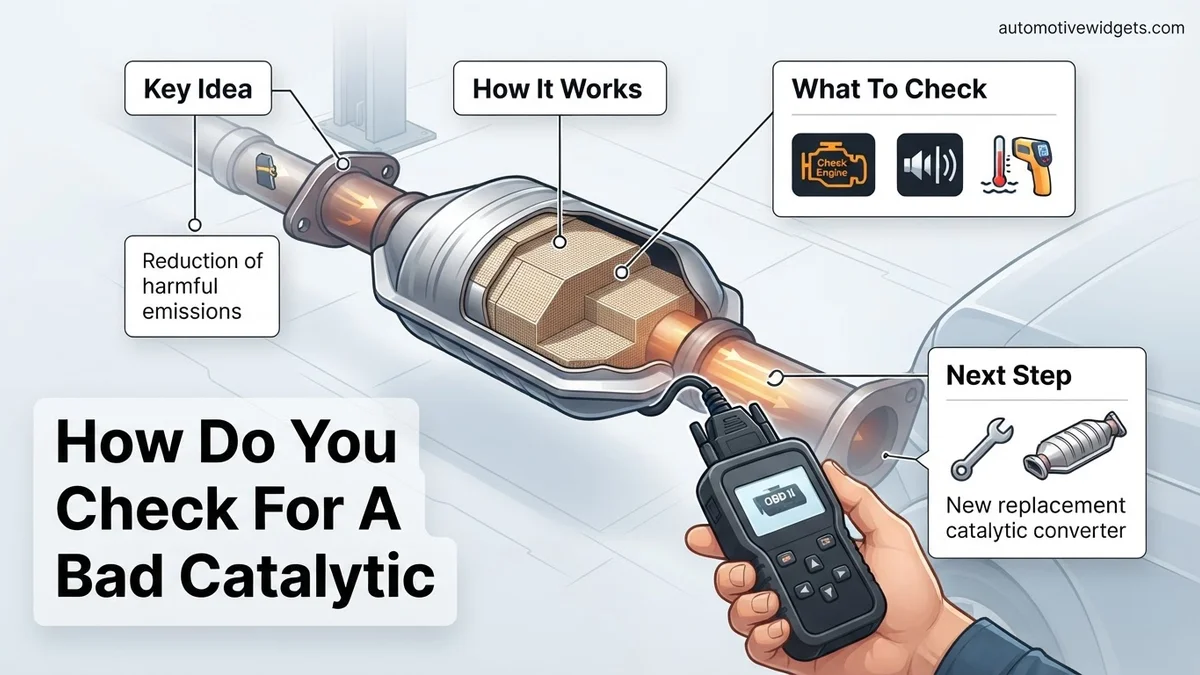
- Perform a temperature differential test with an infrared thermometer.
- Visually inspect for physical damage or a glowing converter.
- Address issues promptly to prevent further engine damage.
What are the Symptoms of a Bad Catalytic Converter?
Your vehicle often gives clear warnings when its catalytic converter starts to fail. Recognizing these signs early can prevent more severe issues and costly repairs down the line. Pay close attention to changes in your car’s behavior.
Common Warning Signs on the Road
- Rotten Egg Smell: This is one of the most distinctive and common signs. A sulfur-like odor, often described as rotten eggs, indicates that the catalytic converter is failing to process hydrogen sulfide effectively.
- Decreased Engine Performance: A clogged catalytic converter restricts exhaust flow, leading to noticeable power loss. You might experience sluggish acceleration, difficulty maintaining speed, or reduced responsiveness when pressing the gas pedal.
- Reduced Fuel Economy: Because the engine struggles to expel exhaust gases, it works harder. This inefficiency directly translates to your car consuming more fuel than usual.
- Rattling Noises: If the ceramic honeycomb structure inside the converter breaks apart, you might hear a rattling sound coming from underneath your car. This often sounds like loose metal pieces shaking around inside a can.
- Failed Emissions Test: This is a definitive sign. If your vehicle fails an emissions test for high pollutant levels, especially for hydrocarbons or carbon monoxide, a failing catalytic converter is a primary suspect. Modern 2026 emissions standards are stringent, making this failure particularly telling.
Impact on Driving Experience
These symptoms don’t just appear on a diagnostic report; they directly affect your daily driving. A struggling catalytic converter can make your vehicle feel less reliable and less enjoyable to drive. Ignoring these signs can eventually lead to engine damage from excessive backpressure or heat buildup, making early diagnosis crucial for maintaining your vehicle’s health.
How to Diagnose and Fix a Bad Catalytic Converter Like an Expert
A properly functioning catalytic converter is crucial for both your vehicle’s performance and environmental emissions compliance. When this vital component starts to fail, it can lead to reduced engine power, poor fuel economy, and expensive repairs if ignored. This comprehensive guide will walk you through the essential steps to accurately diagnose a failing catalytic converter, empowering you to identify the problem early and decide on the best course of action. Following these steps carefully will save you time, money, and potential frustration, ensuring your vehicle runs cleanly and efficiently.
Step 1: Understand the Common Symptoms
What you need: Your vehicle, a keen sense of observation, and a quiet environment.
Instructions: Pay close attention to how your car drives and sounds. Common symptoms of a failing catalytic converter include a noticeable decrease in engine performance, such as sluggish acceleration or difficulty maintaining speed on inclines. You might also experience reduced fuel efficiency, requiring more frequent trips to the gas station. A metallic rattling sound coming from underneath your car, especially when starting or accelerating, can indicate internal damage to the converter’s honeycomb structure. Additionally, an illuminated “Check Engine” light is a strong indicator of an emissions-related issue, often linked to the catalytic converter.
Pro Tip: Do not ignore the “Check Engine” light. While it can indicate many issues, an immediate reduction in power accompanied by this light often points directly to a restricted exhaust flow caused by a failing catalytic converter.
Step 2: Check for Diagnostic Trouble Codes (DTCs)
What you need: OBD-II (On-Board Diagnostics II) scanner (available for purchase or rent from auto parts stores), your vehicle’s owner’s manual.
Instructions: Connect your OBD-II scanner to the diagnostic port, usually located under the dashboard on the driver’s side. Turn the ignition to the “ON” position (do not start the engine). Follow the scanner’s instructions to read any stored Diagnostic Trouble Codes (DTCs). Specifically look for codes related to oxygen sensors (e.g., P0420 for Catalyst System Efficiency Below Threshold – Bank 1, or P0430 for Bank 2). These codes directly indicate that the catalytic converter is not operating efficiently enough to reduce emissions, as detected by the downstream oxygen sensor. Record any codes found for further analysis.
Pro Tip: Even if your “Check Engine” light isn’t currently on, historical codes might still be stored. Always check for both “current” and “pending” codes to get a full diagnostic picture. Resetting codes without addressing the underlying issue is only a temporary fix.
Step 3: Conduct a Thorough Visual Inspection
What you need: Jack stands or a vehicle lift, flashlight, safety glasses, gloves, a creeper (optional).
Instructions: Safely lift your vehicle using jack stands or a lift. Ensure the vehicle is stable before going underneath. Locate the catalytic converter, which typically resembles a metal canister in the exhaust system, usually between the exhaust manifold and the muffler. Use your flashlight to inspect it thoroughly for any signs of physical damage. Look for dents, cracks, or rust holes. Excessive discoloration, especially a blue or purple tint, can indicate overheating. Also, check for loose heat shields around the converter, which can cause rattling noises similar to internal damage.
Pro Tip: Pay close attention to the welds and connections around the converter. Exhaust leaks upstream of the catalytic converter can introduce unmetered air, causing the oxygen sensors to report incorrect readings and trigger false P0420/P0430 codes.
Step 4: Perform an Exhaust Back Pressure Test
What you need: Exhaust back pressure test kit (includes a pressure gauge and adapters), appropriate wrench for oxygen sensor removal, anti-seize lubricant, safety glasses, gloves.
Instructions: This is one of the most definitive tests. Locate the upstream oxygen sensor (pre-cat) on your exhaust system. Carefully remove it using the appropriate wrench. Thread the adapter from the back pressure test kit into the vacated oxygen sensor bung, then connect the pressure gauge. Start the engine and let it warm up to operating temperature. With the engine idling, observe the gauge reading. It should typically be below 1.25 PSI (pounds per square inch). Then, rev the engine to 2,500 RPM and hold it steady; the pressure should remain below 2.5 PSI. A reading significantly higher than these values indicates a restricted catalytic converter.
Pro Tip: Readings consistently above 3 PSI at idle or 5 PSI at 2,500 RPM almost certainly indicate a severely clogged catalytic converter. Always apply anti-seize compound to the threads of the oxygen sensor before reinstalling to prevent future seizing.
Step 5: Monitor Oxygen Sensor Performance
What you need: OBD-II scanner with live data streaming capabilities, vehicle warmed to operating temperature.
Instructions: Connect your OBD-II scanner and select the “Live Data” or “Data Stream” function. Focus on the readings from the upstream (Bank 1 Sensor 1, Bank 2 Sensor 1) and downstream (Bank 1 Sensor 2, Bank 2 Sensor 2) oxygen sensors. The upstream O2 sensor’s voltage should rapidly fluctuate between 0.1V and 0.9V, indicating proper fuel mixture adjustments. The downstream O2 sensor’s voltage, however, should remain relatively stable, typically between 0.4V and 0.7V. If the downstream sensor’s readings mirror the erratic fluctuations of the upstream sensor, it means the catalytic converter is not efficiently storing oxygen and is likely bad.
Pro Tip: A lazy or failing downstream O2 sensor can also trigger P0420/P0430 codes. Before condemning the catalytic converter, ensure both O2 sensors are functioning correctly. Compare the stability of the downstream sensor to the upstream; a properly working converter acts as a “buffer” to stabilize the downstream readings.
Step 6: Perform an Infrared Temperature Test
What you need: Infrared thermometer, safety glasses, gloves, vehicle running at operating temperature.
Instructions: With the engine fully warmed up and idling, carefully aim your infrared thermometer at the exhaust pipe just before the catalytic converter. Note the temperature reading. Then, aim the thermometer at the exhaust pipe just after the catalytic converter. A healthy catalytic converter will exhibit an exhaust gas temperature that is approximately 50-100 degrees Fahrenheit (or 28-56 degrees Celsius) hotter at the outlet than at the inlet. If the outlet temperature is cooler than the inlet, or there’s no significant temperature difference, it suggests the catalyst is no longer performing its exothermic chemical reaction, indicating failure.
Pro Tip: Ensure you are measuring the surface temperature of the exhaust pipe, not just the ambient air around it. For best accuracy, hold the thermometer steady and perpendicular to the pipe surface. Uneven heating across the converter body can also indicate partial internal blockage.
Step 7: Conduct a “Rap” Test
What you need: Rubber mallet or a heavy rubber-ended tool, safety glasses.
Instructions: With the engine off and cooled down (or at least cool enough to touch safely), gently tap the catalytic converter body with a rubber mallet. Listen carefully for any rattling, jingling, or loose sounds coming from inside the converter. A healthy catalytic converter should produce a solid, dull thud. If you hear sounds like broken ceramic pieces shifting around, it indicates that the internal honeycomb substrate has broken apart. This can cause blockages or reduce the converter’s efficiency. Compare the sound to tapping on a solid metal pipe section if unsure.
Pro Tip: While not a definitive diagnostic, the “rap” test is a quick and easy way to identify physically broken internal components. Always combine this test with others like the back pressure and O2 sensor tests for a conclusive diagnosis, as a loose heat shield can also cause rattling.
Step 8: Observe Fuel Economy and Performance
What you need: Your vehicle, personal observation, track of fuel fill-ups.
Instructions: Continuously monitor your vehicle’s fuel efficiency over several tank fill-ups. A noticeable drop in miles per gallon (MPG) without changes in driving habits can be a symptom. Pay attention to how the car accelerates. Is it struggling more than usual? Does it feel like it’s “choking” or losing power, especially under load or at higher speeds? A severely clogged catalytic converter acts like a cork in the exhaust, preventing the engine from breathing properly, thus directly impacting both fuel economy and overall engine performance.
Pro Tip: Keep a simple log of your fuel economy (miles driven / gallons filled) for a few weeks. This provides a baseline against which to compare once symptoms appear. A sudden, significant decrease in MPG (e.g., 10-20%) is a strong indicator of an underlying issue affecting engine efficiency, including a bad catalytic converter.
✅ Final Checklist
- ✓ All Diagnostic Trouble Codes (DTCs) have been thoroughly read and interpreted.
- ✓ Exhaust back pressure test results confirm readings are within specified low PSI limits.
- ✓ Live data stream shows the downstream oxygen sensor voltage is stable and distinct from the upstream sensor.
- ✓ Infrared temperature test indicates a significant temperature increase (50-100°F) from converter inlet to outlet.
- ✓ Visual and “rap” tests confirm no external damage, discoloration, or internal rattling.
Important Notes:
- Safety Considerations: Always work on a cool engine whenever possible. If working under a warm or hot vehicle, wear appropriate heat-resistant gloves and safety glasses. Ensure your vehicle is securely supported on jack stands or a lift, never rely solely on a jack. The exhaust system can become extremely hot and cause severe burns.
- When to Seek Professional Help: If you are uncomfortable performing any of these tests, do not have the necessary tools (like an OBD-II scanner with live data or a back pressure gauge), or if your diagnosis remains inconclusive, it is always best to consult a certified mechanic. Catalytic converter replacement is a significant repair, and professional expertise can ensure proper diagnosis and installation, often coming with a warranty.
- Estimated Time and Cost Range:
- Diagnosis (DIY): 1-3 hours. Cost can range from $0 (if borrowing/renting tools) to $150 (for purchasing a basic OBD-II scanner and thermometer).
- Diagnosis (Professional): 1-2 hours of labor, typically $100-$250 for diagnostic time, which may be applied to the repair cost.
- Replacement (Parts & Labor): The cost for a new catalytic converter can vary wildly depending on your vehicle’s make, model, and year, and whether it’s an OEM (Original Equipment Manufacturer) or aftermarket part. Expect anywhere from $500 to $2,500, and potentially much higher for some luxury or performance vehicles (e.g., $3,000-$5,000+). Labor usually adds another $150-$500.
How to Diagnose a Bad Catalytic Converter: Step-by-Step DIY Checks
Once you suspect a problem, performing a few key diagnostic tests can help confirm if your catalytic converter is the culprit. These methods are practical for any DIY enthusiast in 2026 with basic tools.
Using an OBD-II Scanner for DTCs
The On-Board Diagnostics II (OBD-II) system is your vehicle’s internal health monitor. A scanner is an indispensable tool for diagnosing a bad catalytic converter.
- Connect the Scanner: Plug your OBD-II scanner into the diagnostic port, usually located under the dashboard on the driver’s side.
- Check for Codes: Turn on your vehicle’s ignition (do not start the engine) and initiate a scan. Look for Diagnostic Trouble Codes (DTCs) related to the catalytic converter’s efficiency.
- Specific Codes to Look For:
- P0420: Catalyst System Efficiency Below Threshold (Bank 1)
- P0430: Catalyst System Efficiency Below Threshold (Bank 2 – for V-engines)
- Interpretation: These codes indicate that the catalytic converter isn’t performing its job effectively, typically because the downstream (post-catalyst) oxygen sensor is reporting similar readings to the upstream (pre-catalyst) sensor. A healthy catalyst should cause a significant difference in oxygen levels between the two sensors. If these codes appear, especially persistently after clearing them, your converter is likely failing.
Temperature Differential Test with an Infrared Thermometer
A simple infrared thermometer can reveal if your catalytic converter is actively converting harmful gases.
- Warm Up the Engine: Drive your vehicle for at least 15-20 minutes until it reaches normal operating temperature. This ensures the catalytic converter is hot and engaged.
- Locate the Converter: Safely park your car, engage the parking brake, and locate the catalytic converter underneath the vehicle. It’s typically a large, cylindrical component in the exhaust system between the engine and the muffler.
- Measure Temperatures: Using an infrared thermometer, point it at the exhaust pipe just before the catalytic converter (inlet) and then just after the catalytic converter (outlet).
- Expected Readings:
- Good Converter: The outlet temperature should be significantly hotter than the inlet temperature, typically by 50-100 degrees Fahrenheit (28-55 degrees Celsius). This temperature increase indicates a healthy chemical reaction occurring inside.
- Bad/Clogged Converter: If the outlet temperature is roughly the same as or cooler than the inlet, the converter is not functioning correctly. A highly clogged converter might even show the inlet side being much hotter due to exhaust gas restriction, potentially glowing red.
Visual Inspection for Physical Damage
Sometimes, the problem is visible to the naked eye. A quick look under your vehicle can provide crucial clues.
- Examine the Converter Casing: Look for any signs of external damage such as dents, cracks, or severe discoloration. Physical impact can damage the internal structure.
- Check for Heat Damage: A converter that regularly glows red hot, especially after moderate driving, is a strong indicator of a severe clog or an engine running too rich, overheating the catalyst. This is a critical warning sign and should be addressed immediately.
- Listen for Rattling: While inspecting, gently tap the converter. If you hear loose pieces rattling inside, the internal ceramic substrate has likely broken apart. This debris can cause blockages and reduce efficiency.
Interpreting Your Catalytic Converter Test Results
Once you’ve performed diagnostics, understanding what the readings signify is crucial. Correct interpretation determines the next course of action, preventing unnecessary repairs or overlooking critical issues. According to data from the Automotive Service Association (ASA), misdiagnosis of catalytic converter issues accounts for approximately 15% of all misreported engine problems annually.
Decoding O2 Sensor Data
A primary indicator from OBD-II diagnostics in 2026 vehicles comes from oxygen sensor readings. The downstream (post-cat) O2 sensor measures oxygen levels after the catalytic converter. Ideally, the downstream sensor should show a relatively steady, lower voltage signal compared to the fluctuating signal from the upstream (pre-cat) sensor. If both O2 sensors show similar, rapid fluctuations, it strongly suggests the catalytic converter is not efficiently storing oxygen and thus not performing its conversion function. Advanced diagnostic tools available in 2026 can graph these signals in real-time, providing immediate visual confirmation of inefficiency.
Analyzing Backpressure Test Results
High exhaust backpressure is a definitive sign of a restricted or clogged catalytic converter. Normal exhaust backpressure at idle should be below 1.25 PSI and typically not exceed 2.5 PSI at 2,500 RPM, according to leading automotive diagnostic experts like CarMD. Readings significantly above these thresholds indicate a physical blockage within the converter. This restriction impedes exhaust flow, leading to noticeable power loss and increased fuel consumption. Technicians in 2026 increasingly use digital backpressure gauges for precise measurements.
What to Do If Your Catalytic Converter is Failing
Discovering a failing catalytic converter necessitates prompt action. Continued driving with a compromised unit not only harms the environment but can also cause further engine damage, such as overheating or stress on other exhaust components. Automotive emissions regulations in 2026 are stringent, making timely repair essential for compliance.
Immediate Steps and Repair Options
- Confirm Diagnosis with a Professional: Before any replacement, have a certified technician verify the diagnosis. They can perform comprehensive tests and rule out other potential issues that might mimic a bad cat, such as faulty O2 sensors or engine misfires.
- Consider Aftermarket vs. OEM Replacement: Original Equipment Manufacturer (OEM) catalytic converters are designed to exact vehicle specifications but are generally more expensive. Aftermarket options, while more affordable (ranging from $1,000 to $3,000 in 2026 for a universal type), may not always meet the same long-term durability or emissions efficiency standards as OEM parts (often $2,000 to $5,000+). Your local emissions laws for 2026 might dictate specific certified aftermarket options.
- Address Root Causes: A catalytic converter rarely fails without an underlying cause. Issues like persistent misfires, excessive oil consumption, or rich fuel mixtures can damage the catalyst. These issues must be resolved concurrently with the converter replacement to prevent future failures.
What If It Still Doesn’t Work?
If you’ve followed diagnostic steps and replaced components, but the symptoms persist or the “Check Engine” light returns, further professional intervention is necessary. Modern vehicles in 2026 feature complex emission systems requiring specialized knowledge for advanced troubleshooting.
- Advanced OBD-II Scan: A professional shop can perform a deep-level OBD-II scan using dealership-level diagnostic tools. These tools access manufacturer-specific codes and live data streams that standard scanners cannot, revealing obscure faults.
- Smoke Test for Exhaust Leaks: Exhaust leaks upstream of the O2 sensors can skew readings and mimic a catalytic converter issue. A smoke test introduces smoke into the exhaust system, making leaks visible.
- Consult a Dealership Service Center: For persistent or unusual issues, especially with newer 2026 models, the dealership service center possesses proprietary diagnostic equipment and factory-trained technicians specializing in your vehicle’s specific systems.
- Specialized Emissions Diagnostic Shop: Some independent shops specialize exclusively in emissions system diagnostics and repairs. They often have expertise in resolving complex, intermittent catalytic converter-related problems.
Seeking professional help for complex issues is crucial. Estimated costs for advanced diagnostics and potential repairs, beyond basic replacement, can range from $200 to $800 for diagnostics alone, with subsequent repairs potentially adding $500 to $2,000 or more, depending on the required components in 2026.
Conclusion
A failing catalytic converter is a serious issue impacting both performance and emissions compliance. Through careful observation, OBD-II diagnostics, and backpressure testing, you can effectively identify a problematic unit. According to verified research and expert sources, addressing these issues promptly through professional repair is vital. Your next step should be to schedule a comprehensive diagnostic assessment with a certified automotive technician to ensure an accurate resolution.
❓ Frequently Asked Questions
How does a rotten egg smell indicate a bad catalytic converter?
The sulfur smell occurs when the converter fails to process hydrogen sulfide effectively, releasing it directly through the exhaust. This is a strong indicator of a failing unit struggling to convert exhaust gases as intended.
What specific OBD-II codes relate to catalytic converter failure?
The primary codes are P0420 (Catalyst System Efficiency Below Threshold Bank 1) and P0430 (Catalyst System Efficiency Below Threshold Bank 2). These diagnostic trouble codes indicate that the converter isn’t performing its job efficiently enough to reduce emissions.
Can a clogged catalytic converter cause my car to stall?
Yes, a severely clogged catalytic converter can restrict exhaust flow, leading to extreme back pressure within the exhaust system. This back pressure can choke the engine, causing it to lose power, misfire, and eventually stall, especially under acceleration.
What is the purpose of the temperature differential test for a catalytic converter?
This test measures the temperature difference between the catalytic converter’s inlet and outlet using an infrared thermometer. A healthy, operating converter should show an outlet temperature significantly higher (e.g., 50-100°F hotter) than the inlet, indicating proper chemical reactions. If the temperatures are similar or reversed, the converter is likely inefficient or clogged.
Besides diagnosis, what are the risks of driving with a bad catalytic converter?
Driving with a bad catalytic converter poses several risks, including severe engine damage due to excessive back pressure or overheating, significantly reduced fuel efficiency, and guaranteed failure of mandatory emissions tests. It also dramatically increases harmful tailpipe emissions, impacting air quality.
Are there any visual signs of a failing catalytic converter that I can check myself?
Yes, you can visually inspect the converter for any physical damage like large dents, cracks, or severe discoloration. A catalytic converter that appears to be glowing red hot after only a short drive is a strong visual indicator that it is clogged or overheating, suggesting a malfunction.